
IOT in Manufacturing: Embracing IoT for Unprecedented Growth
Written by Reading progress Call us The manufacturing industry is on the brink of a technological revolution, driven by the advent of the Internet of Things (IoT). From increasing efficiency to improving safety, IoT is t…
IOT in Manufacturing: Embracing IoT for Unprecedented Growth
Written by
vedant@aican.co.in
Reading progress
A Brief History of IoT in Manufacturing
The concept of IoT, a network of interconnected devices, has evolved over the past few decades. Initially, the idea was to connect simple systems to the internet, but today, IoT encompasses sophisticated technologies like ERP manufacturing software that streamline operations and enhance productivity.
The Benefits of IoT in Manufacturing
Implementing IoT in manufacturing offers numerous benefits:
- Increased efficiency and productivity: IoT enables real-time monitoring and control of machinery, reducing downtime and optimizing performance.
- Reduced downtime and improved maintenance: Predictive maintenance helps in identifying potential issues before they cause significant problems, thereby reducing downtime.
- Better quality control and product design: IoT sensors provide detailed data that can be used to improve quality control processes and product designs.
- Greater visibility into the supply chain due to real-time data: Enhanced visibility helps in efficient inventory management and reduces waste.
- Improved safety for workers: IoT devices monitor working conditions, ensuring a safer environment for employees.
- Reduced costs associated with inventory management and waste: Better tracking and management of inventory lead to significant cost savings.
Challenges of IoT in Manufacturing
While the benefits are significant, there are several challenges to implementing IoT in manufacturing:
- Security concerns: With more devices connected to the internet, the risk of cyber-attacks increases.
- Data overload: Managing and analyzing vast amounts of data can be overwhelming.
- Implementation costs: The initial investment in IoT infrastructure can be high.
- Change management: Adapting to new technologies requires a cultural shift and retraining of employees.
Trends in IoT for Manufacturing
The global IoT in manufacturing market size is projected to grow from USD 33.2 billion in 2020 to USD 53.8 billion by 2025, with a Compound Annual Growth Rate (CAGR) of 10.1%. Here are some trends shaping the future:
- 5G: Faster and more reliable connectivity for IoT devices.
- Predictive maintenance: Using IoT to predict and prevent equipment failures.
- Augmented reality (AR): Enhancing operations and maintenance through AR.
- Edge computing: Processing data closer to the source to reduce latency.
- Blockchain: Securing data transactions and improving transparency.
Real-Time Examples of IoT in Manufacturing
Several leading companies are leveraging IoT to optimize their manufacturing processes:
- General Electric (GE): Uses IoT to monitor and improve their manufacturing processes.
- BMW: Employs IoT in its factories for enhanced efficiency and quality control.
- Philips: Utilizes IoT to streamline its manufacturing operations.
- Cimpress: Adopts IoT for better asset tracking and management.
- Owens Corning: Implements IoT for predictive maintenance and improved safety.
Applications of IoT in Manufacturing
Machine Monitoring
IoT enables manufacturers to monitor machines in real-time, helping identify potential issues before they cause major problems. This leads to reduced downtime and increased productivity.
Quality Control
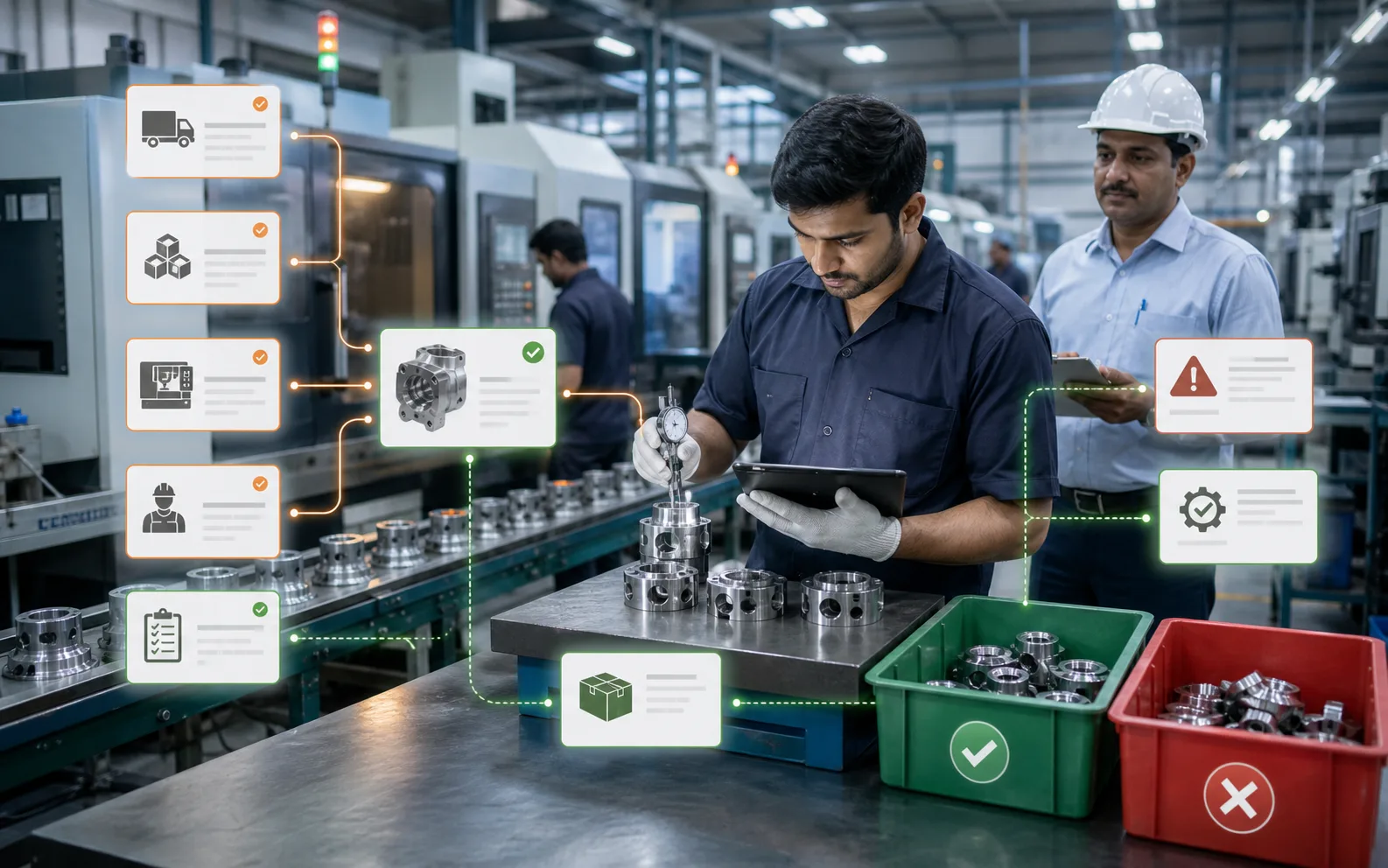
By integrating IoT sensors into the production line, manufacturers can ensure that products meet quality standards. This real-time monitoring allows for immediate adjustments, improving overall product quality.
Supply Chain Management
IoT provides greater visibility into the supply chain, allowing manufacturers to track inventory levels, manage logistics, and reduce waste. This leads to more efficient operations and cost savings.
Safety
IoT devices monitor working conditions and equipment performance, ensuring a safer environment for workers. This includes tracking hazardous materials and ensuring compliance with safety regulations.
Future Outlook: The Impact of IoT on MSME Manufacturers
As IoT continues to evolve, its impact on MSME manufacturers will be profound. From improved efficiency on the production floor to enhanced machine utilization, the possibilities are endless. Companies like AICAN Optiwise are simplifying end-to-end operations for MSME manufacturers, offering affordable pricing and customizations on the go.
IoT in Manufacturing: Case Studies
General Electric
GE has integrated IoT into its manufacturing processes to monitor equipment performance and improve overall efficiency. This has resulted in reduced downtime and increased productivity.
BMW
BMW’s factories are equipped with IoT devices that track production metrics in real-time, enabling better quality control and faster response times to potential issues.
Philips
Philips uses IoT to manage its manufacturing processes more efficiently, leading to significant cost savings and enhanced product quality.
Why Is IoT Gaining Traction in 2024 and Beyond?
The adoption of IoT in the manufacturing industry is driven by several factors:
- Cost reduction: IoT helps in reducing operational costs through efficient inventory management and predictive maintenance.
- Mass customization: IoT enables manufacturers to offer customized products at scale.
- Efficient inventory management: Real-time data provides better insights into inventory levels, reducing excess stock and waste.
- Agile operations: IoT allows for more flexible and responsive manufacturing processes.
- Shorter time to market: Faster production cycles lead to quicker delivery of products to market.
Components of IoT in Manufacturing
The IoT ecosystem in manufacturing comprises several key components:
- Digital equipment: Machines and devices connected to the internet.
- Plants instrumentation: Sensors and instruments that monitor various parameters.
- Edge devices: Devices that process data locally to reduce latency.
- Embedded systems: Microprocessors and controllers that manage IoT devices.
- Data communication infrastructure: Networks that facilitate data transfer.
- Software and analytics: Tools for data analysis and decision-making.
Future Outlook: The Impact of IoT on MSME Manufacturers
As IoT continues to evolve, its impact on MSME manufacturers will be profound. From improved efficiency on the production floor to enhanced machine utilization, the possibilities are endless. Companies like AICAN Optiwise are simplifying end-to-end operations for MSME manufacturers, offeringaffordable pricing and customizations on the go.
Explore More
In conclusion, IoT is revolutionizing the manufacturing industry by providing innovative, cost-efficient solutionsthat drive growth and sustainability. The future of manufacturing lies in embracing these technologies to stay competitive and meet the evolving demands of the market.
Feel free to reach out to us at AICAN Optiwise to learn more about how we can help your business leverage IoT for greater efficiency and success.

Related Posts

Is AI Worth the Investment for My Factory?
Learn how to decide if AI is worth the investment for your factory by evaluating use cases, data readiness, costs, risks, ROI, and operational impact.
13 Jun 2026Read more →Manufacturing AI Mistakes to Avoid Before You Start
List manufacturing AI mistakes and controls for unclear use case, messy data, unsafe automation, no owner, weak security and unreviewed recommendations.
13 Jun 2026Read more →What's the Difference Between AI and Regular Automation?
Understand the difference between AI and regular automation in manufacturing, with practical examples for workflows, decisions, alerts, and predictive operations.
13 Jun 2026Read more →What Are the Risks of Using AI in Manufacturing?
Understand the risks of AI in manufacturing, including bad data, wrong recommendations, safety issues, security, job fear, over-automation, and implementation failure.
13 Jun 2026Read more →