
Optiwise vs SAP AI: Agents, IoT & Manufacturing Workflows
Use Optiwise AI to ask questions and act on connected manufacturing records. Compare the approach with SAP Joule and explore our factory workflows.
Give your team AI that works with the factory records they use every day. In Optiwise, specialized agents help you retrieve order, material and vendor information and carry out permitted actions in natural language. Bring business AI and machine intelligence together with manufacturing ERP, industrial IoT and no-code workflows in Optiwise.
AI in the business workflow
SAP also offers AI through Joule assistants. The useful comparison is how AI works with your operating records and processes. Optiwise connects our agents directly to production, purchasing, inventory, sales and task workflows.
| Area | Optiwise | SAP Joule |
|---|---|---|
| Business context | Work from connected production, purchasing, inventory, sales and task records. Ask about an order or vendor history and use the factory context already inside Optiwise. | Role and process context across SAP business workflows. |
| Actions | Move from a question to an operating action in natural language—for example, recording received material. Optiwise routes the request to the relevant agent and applies your role permissions. | Assistants coordinate agents to execute business workflows. |
| Organization | Use specialized agents for production, sales, purchase, inventory, tasks and AI/IoT. Intent-based routing and multilingual interaction help the team get work done without choosing a module first. | Assistants organized by business function. |
Product reference: SAP Joule assistants.
AI across your business and your machines
One conversation, the right department
Ask about an order, look up past vendor quotes or instruct the system to record received material. Optiwise identifies the intent, routes it to the relevant agent and works with connected records under your role permissions. Multilingual interaction makes it accessible to your factory team.
AI that also understands machine signals
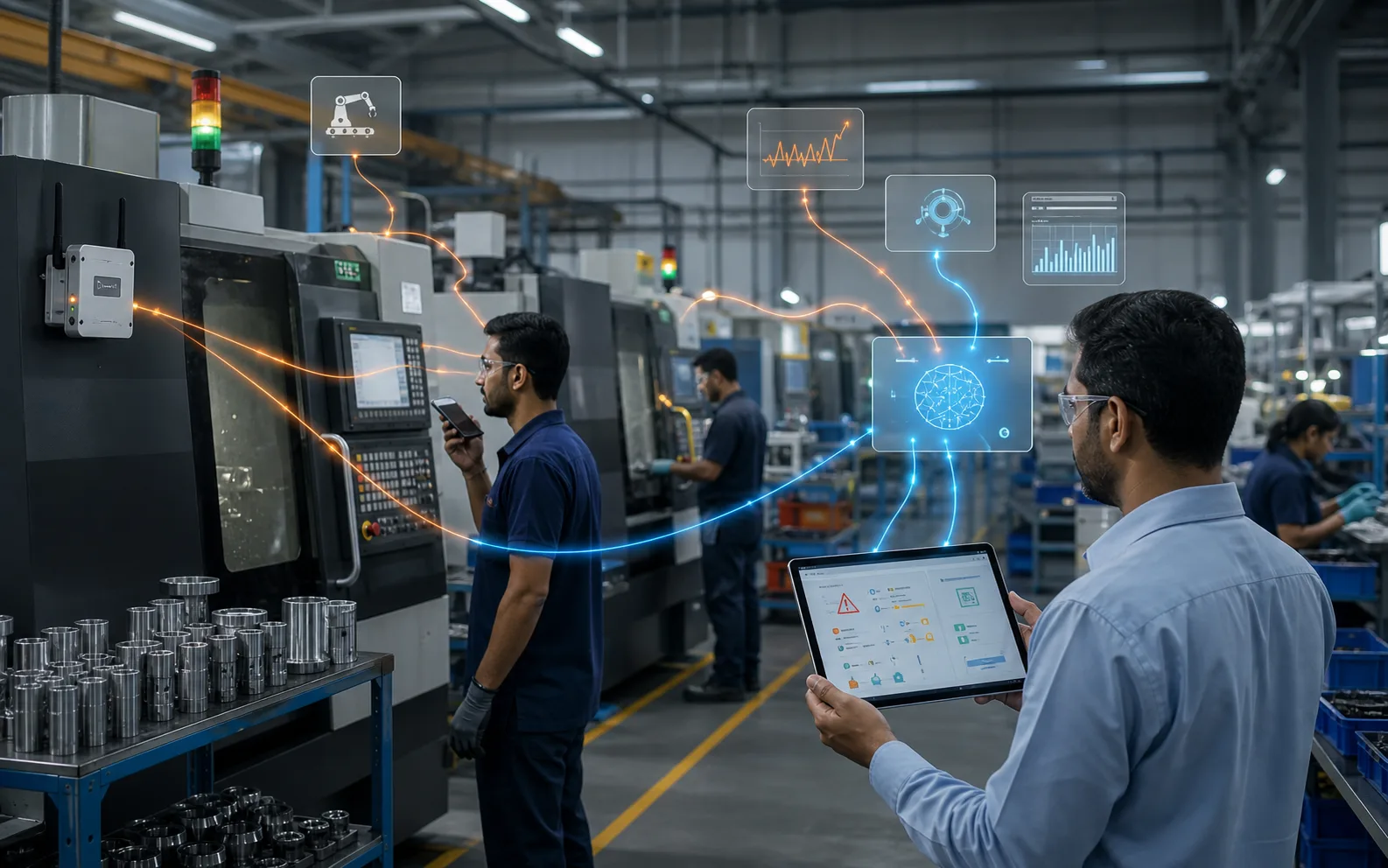
Our AI and IoT layer brings machine-health signals, OEE, downtime and energy analysis into the factory platform. Connect gateways, power monitors and vibration sensors; use anomaly alerts and plant-to-machine dashboards to investigate the equipment that needs attention.
A manufacturing system underneath the AI
Run sales, BOM planning, work orders, procurement, inventory, subcontracting and quality in Optiwise. Extend those records with no-code modules, formulas, rollups and automations, so your AI works on the operating system your teams actually use.
Explore Optiwise AI agents · Explore industrial IoT · Explore no-code customization
Ask the agent that understands the work
Use Rohit for production, Rishabh for inventory and Smriti for sales and CRM. Our purchase AI agent works with vendor and purchasing records, while task agents support assigned work. Multilingual interaction lets the team use familiar language.
Ask for an order’s status or a vendor’s quotation history. Initiate an action such as recording received material within your role permissions. The request operates on the connected business system.
Keep the planning inputs connected
Smart Suggest checks BOM demand, available stock, existing production and pending purchases to calculate action quantities. Vendor selection combines quotations with delivery, quality and price history. The value comes from connecting the question or action to the records behind it.
Build your own workflow around the agents
Create custom modules, forms, related records and event-based automations in Optiwise. Use role permissions and approvals to control actions. Your factory process and its data stay connected as the system grows.
Meet the Optiwise AI agents · Build your workflow · Book a demo
Questions about AI ERP
Does SAP have AI capabilities?
Yes. SAP offers Joule assistants and AI agents for business functions. Optiwise provides specialized agents within its connected manufacturing operating system.
Can Optiwise AI perform actions?
Yes. Optiwise supports natural-language actions on connected business records within role permissions, alongside operational queries.
Does Optiwise include industrial IoT and AI?
Yes. Optiwise combines manufacturing ERP and shop-floor execution with industrial IoT and specialized AI agents. Connect machines through gateways and sensors, track OEE, downtime and energy, and use natural-language queries and actions across production, purchasing, inventory, sales and tasks. No-code modules and automations let you extend the workflow.
Related Posts
Is AI Worth the Investment for My Factory?
Learn how to decide if AI is worth the investment for your factory by evaluating use cases, data readiness, costs, risks, ROI, and operational impact.
13 Jun 2026Read more →Manufacturing AI Mistakes to Avoid Before You Start
List manufacturing AI mistakes and controls for unclear use case, messy data, unsafe automation, no owner, weak security and unreviewed recommendations.
13 Jun 2026Read more →What's the Difference Between AI and Regular Automation?
Understand the difference between AI and regular automation in manufacturing, with practical examples for workflows, decisions, alerts, and predictive operations.
13 Jun 2026Read more →What Are the Risks of Using AI in Manufacturing?
Understand the risks of AI in manufacturing, including bad data, wrong recommendations, safety issues, security, job fear, over-automation, and implementation failure.
13 Jun 2026Read more →