
How Long Does It Take to Implement Shop Floor AI?
Shop floor AI implementation can take weeks to months depending on data, workflows, integrations, training, IoT readiness, and rollout scope.
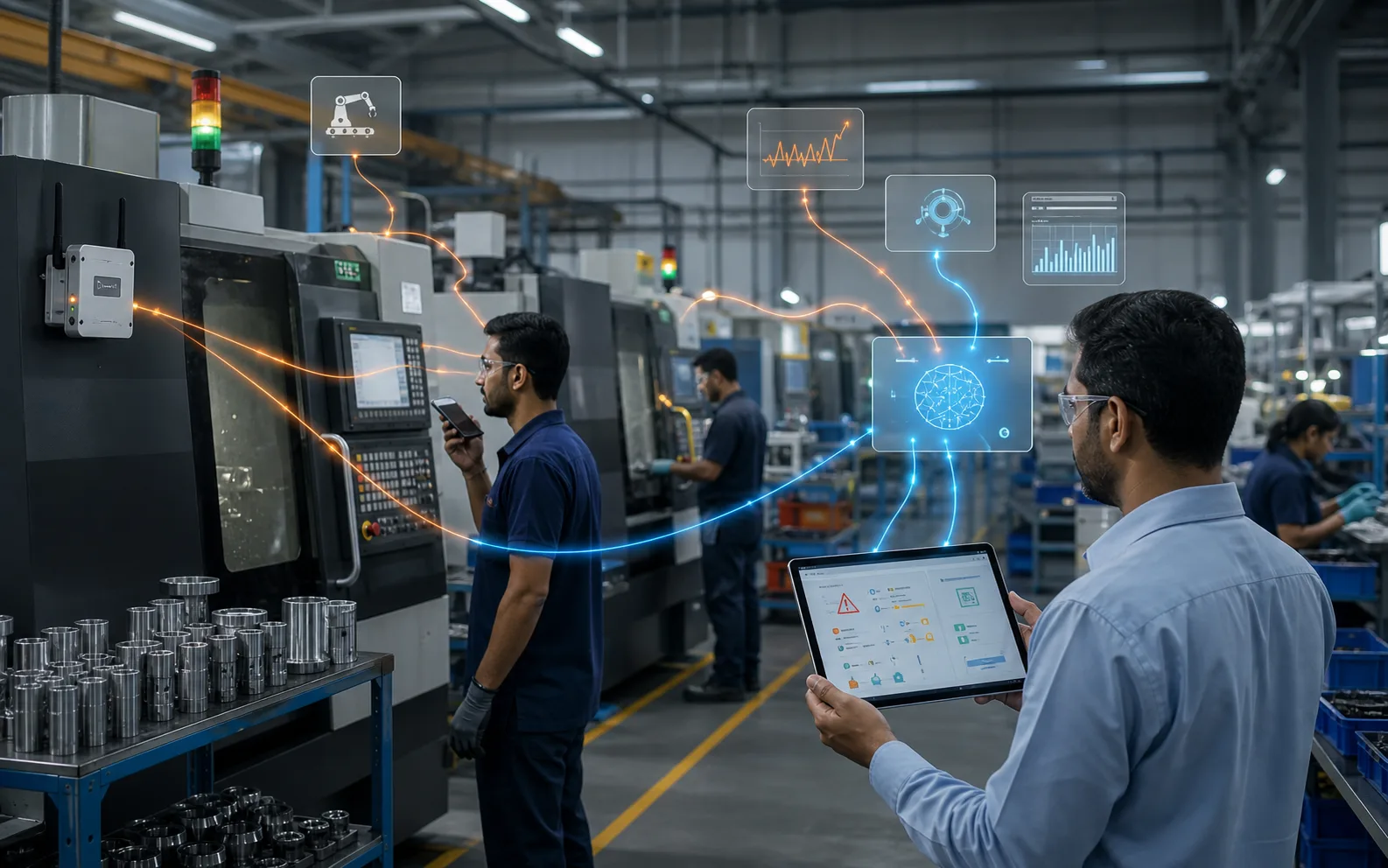
How Long Does It Take to Implement Shop Floor AI?
Shop floor AI implementation can take a few weeks for a focused pilot or several months for a broader rollout.
The timeline depends on factory size, process complexity, data availability, integrations, IoT readiness, user training, and the number of workflows being digitized.
A realistic timeline is better than a rushed launch.
Phase 1: Discovery and Process Mapping
The first phase identifies what problem AI should solve.
Is the goal production visibility, downtime reduction, quality tracking, maintenance alerts, inventory coordination, or reporting?
Clear scope saves time later.
Phase 2: Data and Workflow Setup
AI needs structured data.
This may include machine data, downtime reasons, production orders, item master, quality checks, operator inputs, and maintenance logs.
AICAN Optiwise helps manufacturers connect these workflows across production, inventory, purchase, sales, finance, reports, IoT readiness, and AI processes.
Phase 3: Pilot Rollout
A pilot may focus on one line, one department, or one workflow.
This allows the team to test accuracy, usability, and adoption before scaling.
Phase 4: Training and Go-Live
Supervisors, operators, maintenance teams, and managers need role-based training.
Go-live should include support for early issues.
Phase 5: Optimization
After launch, review alerts, reports, user behavior, data quality, and workflow gaps.
AI improves as the system receives cleaner and more consistent data.
Where AICAN Optiwise Fits
AICAN Optiwise supports phased shop floor AI adoption by linking factory activity with wider business operations. This helps manufacturers start focused and expand intelligently.
Learn more at About AICAN.
Founder’s Note
Implementation time should be judged by readiness, not impatience. A well-prepared pilot can create more trust than a hurried full rollout.
AI succeeds when teams understand the process and believe the data.
FAQ
Can shop floor AI be implemented in one month?
A focused pilot may be possible, but broader rollout usually takes longer.
What slows implementation?
Poor data, unclear workflows, weak training, and integration complexity.
Should implementation be phased?
Yes. A phased rollout reduces risk and improves adoption.
Does IoT readiness matter?
Yes, especially for machine data and predictive maintenance use cases.
Final Thought
Shop floor AI implementation is a journey from visibility to prediction to better decisions.
Start with a clear problem, train users well, and expand after the system proves value. That is the practical path AICAN supports.

Related Posts
Is AI Worth the Investment for My Factory?
Learn how to decide if AI is worth the investment for your factory by evaluating use cases, data readiness, costs, risks, ROI, and operational impact.
13 Jun 2026Read more →Manufacturing AI Mistakes to Avoid Before You Start
List manufacturing AI mistakes and controls for unclear use case, messy data, unsafe automation, no owner, weak security and unreviewed recommendations.
13 Jun 2026Read more →What's the Difference Between AI and Regular Automation?
Understand the difference between AI and regular automation in manufacturing, with practical examples for workflows, decisions, alerts, and predictive operations.
13 Jun 2026Read more →What Are the Risks of Using AI in Manufacturing?
Understand the risks of AI in manufacturing, including bad data, wrong recommendations, safety issues, security, job fear, over-automation, and implementation failure.
13 Jun 2026Read more →