
Compressed-Air Leaks: A Repair and Verification Register
Turn a leak survey into prioritised repairs and verified closure. Includes a labelled energy-cost estimate and checks for measured savings.

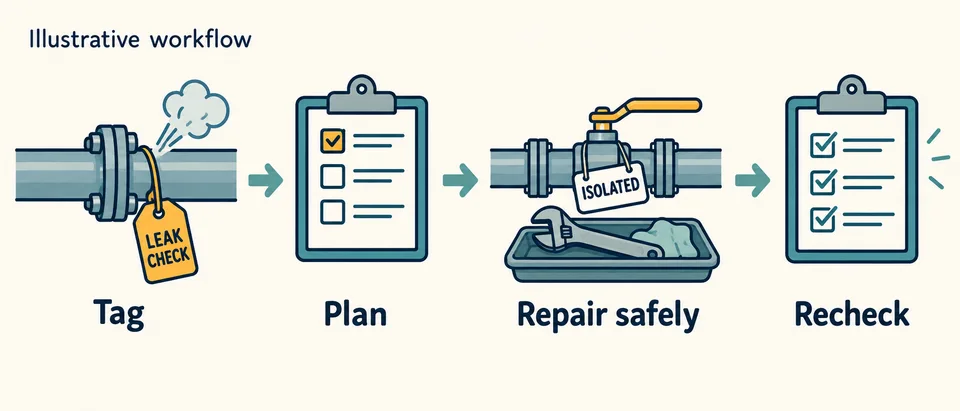
A compressed-air leak register should connect each tagged leak to a planned repair and a recorded recheck. Prioritise operational and safety needs first, then compare credible loss estimates and repair effort without treating every estimated leak as a measured energy saving.
This workflow is for a utilities engineer and maintenance planner turning a leak survey into completed work. Use it when suspected leaks have been identified but repairs, repeat findings or savings estimates cannot be traced to individual locations.
Give every suspected leak a stable identity
Record the asset and exact location, detection date, operating condition, detection method and whether the finding is confirmed. Keep a photograph or location description that lets the assigned technician find the same point. A vague note such as “air line near press” cannot support a reliable before-and-after check.
The US Department of Energy's compressed-air leak tip sheet recommends a leak detection and repair programme that includes identification, tracking, repair and verification. Use a qualified person's assessment for loss estimates. The worksheet below organises the work and evidence.
| Stage | Record | Completion evidence |
|---|---|---|
| Survey | Tag ID, location, method, date and system condition | Finding can be located and reproduced |
| Priority | Process impact, hazard assessment, estimated loss and confidence | Reason for repair order is recorded |
| Plan | Parts, competent owner, isolation requirements and outage window | Approved work package |
| Repair | Work performed and component reference | Maintenance completion record |
| Recheck | Method, operating condition, result and reviewer | Leak resolved or follow-up work raised |
Use estimates to choose work, then measure the result
Illustrative calculation: assume an assessed leak flow of 6 cubic feet per minute, 2,400 pressurised hours per year and an estimated compressor input of 0.18 kilowatts per cubic foot per minute at the relevant operating point. The screening energy estimate is 6 × 0.18 × 2,400 = 2,592 kilowatt-hours per year.
At an illustrative electricity rate of ₹8 per kilowatt-hour, that is ₹20,736 per year. A ₹3,600 repair would have a simple screening payback of about 2.1 months if that full energy reduction were realised. These inputs are invented to explain the calculation; they are not a measured factory result or a forecast for your compressor.
Actual electricity reduction depends on compressor controls, loading, pressure and operating hours. Repairing a leak does not guarantee that input power falls in direct proportion to the estimated airflow. Keep the screening estimate separate from measured post-repair consumption and record the conditions used for comparison.
Plan safe repair and a comparable recheck
The maintenance owner determines the authorised procedure, including isolation and removal of stored pressure where required. Do not tighten, dismantle or improvise repairs on pressurised equipment from this worksheet. Follow the equipment instructions and the site's safe system of work.
After repair, recheck the same location using an appropriate method under a recorded operating condition. A silent pipe in an unpressurised system does not prove the leak has been resolved. If the finding recurs, link it to the original tag so repeat failures remain visible.
Where a repair must wait for an outage, keep the reason, owner and planned window in the register. Escalate changes in process impact through the utilities and production owners rather than raising pressure to compensate without review.
Track the programme in Optiwise
With our no-code forms, attachments and linked records, you can configure a leak register that links a tag to repair and verification evidence. Our industrial IoT offering includes machine power and energy visibility; use the appropriate measured boundary and controls when assessing an energy change.
Review tags awaiting diagnosis, overdue repairs, repairs awaiting recheck and repeat findings. The first acceptance test is that every closed tag has a dated verification result. Report verified closure and measured energy change as separate outcomes.
Leak programme questions
Should the loudest leak always be repaired first?
No. Review safety, process impact, credible loss evidence and the work needed. Sound alone does not establish the complete priority.
Can estimated airflow savings be reported as electricity savings?
Label them as estimates. Use measured input-power or energy evidence, with operating conditions recorded, to report an actual electricity change.
Bring a leak survey and one completed repair record to an Optiwise workflow demo.
Related Posts

Fabric Shade Groups: Allocate Rolls to a Cutting Lay
Allocate fabric rolls to cutting lays with shade-group approval, usable-length checks and remnant identity. Includes a two-group worked allocation example.
30 Sept 2026Read more →
Powder Coating Reclaim: Keep Each Blend Traceable
Build a powder-coating reclaim record with parent lots, approved blend rules, mass reconciliation and job links. Includes a clearly illustrative balance example.
30 Sept 2026Read more →
Torque Tool Job Changes: Record the Approved Setting
Use a torque-tool job-change record to connect joint revision, units, tool identity, setup verification and the first affected assembly without inventing settings.
30 Sept 2026Read more →Opened Adhesive Containers: Record Dates Before Reissue
Track partially used adhesive containers with opening dates, supplier limits, storage exceptions and an issue-return worksheet. Avoid invented expiry extensions.
30 Sept 2026Read more →