
Powder Coating Reclaim: Keep Each Blend Traceable
Build a powder-coating reclaim record with parent lots, approved blend rules, mass reconciliation and job links. Includes a clearly illustrative balance example.

Give each approved powder-coating blend its own identity and retain the virgin and reclaim parent lots. Record the permitted product-specific reclaim rule, actual input masses, acceptance evidence and jobs supplied. Keep uncertain reclaim separate until its identity and use are authorised.
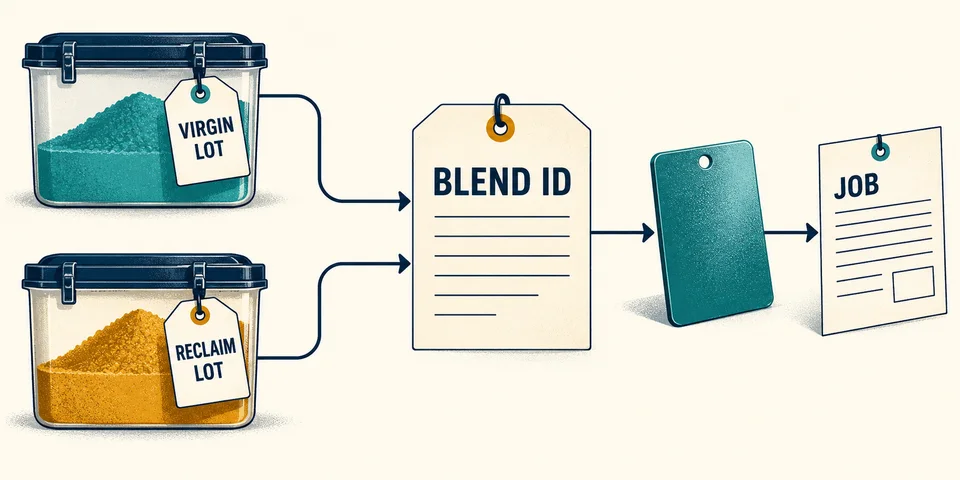
A reclaimed-powder container labelled only with a colour name does not establish its product, source batch or operating history. Once that material enters another blend, a missing identity can spread to every job that uses it.
Identify the reclaim before planning reuse
The coating supervisor owns the blend record with stores and quality. Start when reclaimed powder is collected for possible reuse or a production blend is replenished. Bring the product specification, current supplier instructions, virgin lot, reclaim source, approved application conditions and acceptance requirements.
Keep product compatibility and appearance approval separate from quantity arithmetic. Similar colour is not permission to mix products. Record the reclaim's collection source and status, including any uncertainty about contamination or mixed origins. The authorised process owner decides whether it is eligible.
| Field | Evidence to preserve |
|---|---|
| Blend ID | Unique identity for the controlled blend or defined replenishment interval |
| Virgin input | Product, supplier lot and actual mass |
| Reclaim input | Reclaim ID, originating lot/job and actual mass |
| Permitted rule | Current product-specific instruction and approved operating conditions |
| Acceptance | Test-panel or other required result, reviewer and release |
| Use | Coating line, job, time/output boundary and quantities issued |
| Remainder | Returned mass, container identity, status and next disposition |
Keep the supplier's conditions with the blend
TIGER's metallic-effect application guidance discusses batch consistency, reclaim control and acceptance testing on the application equipment. Those instructions concern the products and conditions described. They do not establish one reclaim percentage for every powder, finish or customer requirement.
Record the actual approved rule for your product instead of copying a general percentage into the register. A retained test panel must identify the blend and conditions it represents. A panel from a different lot or setup cannot silently become the approval for today's blend.
Reconcile a blend without treating it as a recipe
Illustrative mass balance only: a process owner has separately approved a particular use. The recorded inputs are 18 kg from virgin lot V-17 and 2 kg from reclaim R-06. The blend mass is 20 kg; the recorded reclaim share is 2 ÷ 20 × 100 = 10%. These numbers demonstrate record arithmetic, not a recommended mixing ratio.
The blend supplies 12 kg to job A, 6 kg to job B, leaves 1.8 kg as identified remainder and has 0.2 kg of recorded loss. The balance is 12 + 6 + 1.8 + 0.2 = 20 kg. If the records account for only 19.6 kg, retain the 0.4 kg difference for investigation. Do not invent a loss line to force the worksheet to balance.
Record net powder mass using the approved weighing method and units. A container's gross weight cannot be compared directly with net issue quantities. Where measurement resolution affects reconciliation, use the site's approved tolerance and preserve the underlying readings.
Trace replenishment and partial returns
If new parent material enters an active blend, define a new blend identity or a controlled event boundary under the approved process. Retain which jobs could have received material before and after the change. A continuous hopper process may need a time and output interval rather than a simple discrete batch label.
Return unused powder under its actual identity and status. Do not relabel a blend remainder as the original virgin lot. Unknown reclaim stays outside eligible inputs until the designated owner resolves it. Disposal and handling follow the applicable product and site procedures.
Prove that one job can be traced both ways
Choose one completed job. The reviewer should recover its blend, all parent inputs, applicable rule and acceptance evidence. Starting from a reclaim ID, the reviewer should also identify every blend and job that received it. Reconcile the recorded masses and assign any difference. Those are measurable acceptance checks for the register.
We provide batch identities, related records and configurable QC parameters in Optiwise inventory and production workflows. Configure the blend relationships and acceptance record around the process. The configured record preserves the approval; it does not choose a coating formulation.
Powder reclaim questions
Can matching colour names establish compatibility?
No. Product identity and the approved supplier/process requirements govern eligibility. A colour label alone does not establish chemistry, condition or permission to blend.
Can a remainder keep the original virgin-lot label?
Keep its actual blend identity and parent links. Calling a mixed remainder virgin material loses the reclaim history needed for later decisions.
Bring one approved blend record to an Optiwise demo and trace its inputs and jobs with us.
Related Posts

Fabric Shade Groups: Allocate Rolls to a Cutting Lay
Allocate fabric rolls to cutting lays with shade-group approval, usable-length checks and remnant identity. Includes a two-group worked allocation example.
30 Sept 2026Read more →
Torque Tool Job Changes: Record the Approved Setting
Use a torque-tool job-change record to connect joint revision, units, tool identity, setup verification and the first affected assembly without inventing settings.
30 Sept 2026Read more →
Opened Adhesive Containers: Record Dates Before Reissue
Track partially used adhesive containers with opening dates, supplier limits, storage exceptions and an issue-return worksheet. Avoid invented expiry extensions.
30 Sept 2026Read more →Hydraulic Oil Sample Register: Preserve Machine and Sample Context
Keep hydraulic oil analysis traceable with a sample-context register covering machine identity, sample point, hours, top-ups, report matching and exceptions.
30 Sept 2026Read more →