
Fabric Shade Groups: Allocate Rolls to a Cutting Lay
Allocate fabric rolls to cutting lays with shade-group approval, usable-length checks and remnant identity. Includes a two-group worked allocation example.

Allocate fabric to a cutting lay by approved shade group as well as available length. Keep each roll, released segment, lay and remnant identifiable. When the shade status of a roll changes, revise the allocation before cutting rather than treating the remaining length as interchangeable stock.
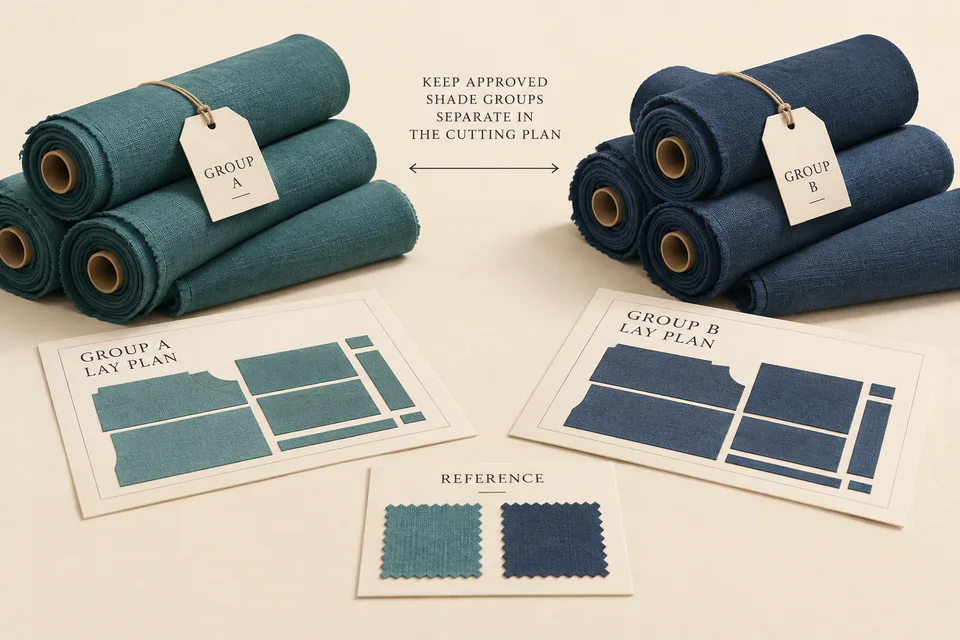
The cutting plan has enough metres on paper, but the rolls belong to two shade groups. Combining them may satisfy the length total while violating the approved appearance requirement for the garment or panel set.
Release the roll group before allocating length
The cutting planner owns the allocation; textile quality approves shade grouping and the permitted use. Start when an order needs multiple rolls, when a replacement roll is proposed or when inspection identifies variation within a roll. Bring the style or order requirement, approved colour reference, roll inspection records, usable widths and lengths, and the marker or lay requirements.
X-Rite's textile colour guidance describes visual and instrumental control across textile production. Your customer and quality procedure must define the viewing, measurement and acceptance conditions. This allocation worksheet supplies no universal colour tolerance.
| Record | Required identity and decision |
|---|---|
| Order and components | Style, colour, sizes and parts that must match |
| Roll or released segment | Supplier lot, roll ID and identifiable segment boundaries |
| Shade group | Approved group and quality-release reference |
| Usable material | Verified length, width and relevant exclusions |
| Lay allocation | Lay ID, assigned roll/segment and planned length |
| Actual use | Cut length, recorded loss and remaining identified material |
| Change approval | Replacement roll, revised group decision and affected bundles |
Calculate what fits within each approved group
Illustrative scenario: rolls R1 and R2 belong to approved group A and have 120 m and 90 m of usable fabric. Group A therefore has 210 m. Roll R3 has 110 m in group B. A particular lay requires 180 m and the approved plan keeps its matching components within one group.
Allocate 120 m from R1 and 60 m from R2 to that lay. Group A retains 30 m under R2's identity. R3's 110 m stays in group B. Total available stock was 320 m, but that total alone could not establish whether one approved group could satisfy the lay.
The example assumes verified usable lengths and compatible width and marker requirements. It excludes spreading losses and end allowances; include those in a real requirement before release. After cutting, reconcile actual use rather than carrying the planned remainder forward automatically.
Preserve segment and bundle identity
If inspection finds a shade change partway through a roll, quality decides whether defined segments can be used and how they must be identified. Retain the parent roll and the approved segment boundaries. Do not assign the whole roll to the first acceptable group and ignore the later variation.
Keep the lay and cut-bundle records connected to the rolls or segments used. The required detail depends on the matching rule: pieces from a garment, visible panel set or paired assembly may need to remain together. A remnant should retain enough identity to reconstruct that origin at its next issue.
When a planned roll becomes unavailable, check the replacement's released group, usable length and other requirements before substitution. A planner's edit to the quantity field does not approve a shade change. Record which not-yet-cut lays and already-cut bundles are affected by a revised decision.
Resolve exceptions before closing the lay
If physical tags and the allocation disagree, hold the affected allocation for quality review under the site's procedure. Keep unknown material distinct from approved stock. Do not infer a group from a screen image or from rolls standing beside it.
Acceptance requires every allocated roll or segment to have a current approval and every actual issue to map to a lay. Reconcile issued material into actual cut use, recorded loss and identified remainder using the same unit. A reviewer should be able to start with one finished bundle and recover its lay and source rolls.
Our Optiwise batch records, no-code relations and configurable QC parameters can connect roll identities, release decisions and lay records. Configure the shade-group and segment fields for your operation. We retain the operational record while your quality team owns the colour acceptance method.
Fabric allocation questions
Can one supplier dye lot contain more than one shade group?
Use the actual inspection and approval. Supplier-lot identity and the group accepted for a particular use are different fields; one must not silently stand in for the other.
Should a returned remnant receive a new supplier lot?
No. Retain the original source identity and give the remnant its own traceable reference where needed. Record its remaining length, group and current release status.
Bring a two-group roll allocation to an Optiwise demo and map the lay and remnant records.
Related Posts

Powder Coating Reclaim: Keep Each Blend Traceable
Build a powder-coating reclaim record with parent lots, approved blend rules, mass reconciliation and job links. Includes a clearly illustrative balance example.
30 Sept 2026Read more →
Torque Tool Job Changes: Record the Approved Setting
Use a torque-tool job-change record to connect joint revision, units, tool identity, setup verification and the first affected assembly without inventing settings.
30 Sept 2026Read more →
Opened Adhesive Containers: Record Dates Before Reissue
Track partially used adhesive containers with opening dates, supplier limits, storage exceptions and an issue-return worksheet. Avoid invented expiry extensions.
30 Sept 2026Read more →Hydraulic Oil Sample Register: Preserve Machine and Sample Context
Keep hydraulic oil analysis traceable with a sample-context register covering machine identity, sample point, hours, top-ups, report matching and exceptions.
30 Sept 2026Read more →