
Plating Returns: Reconcile Each Lot Before Releasing Stock
Keep source lots intact through outside plating. Reconcile partial returns, quality holds and rework dispatches with a worked Optiwise material balance.


Receive plated parts against the source lot and outside-work record before releasing them to the next job. In Optiwise, we connect the subcontract service order, material challans, partial receipts and quality decisions so you can follow both the quantity still outside and the stock ready to use.
You send two lots of the same fastener to a plater. A return contains 800 pieces in one mixed bag. The count may be correct, but the bag no longer tells you which source lot, process record or inspection evidence belongs to each piece. Accepting 800 pieces into usable stock would hide that missing history.
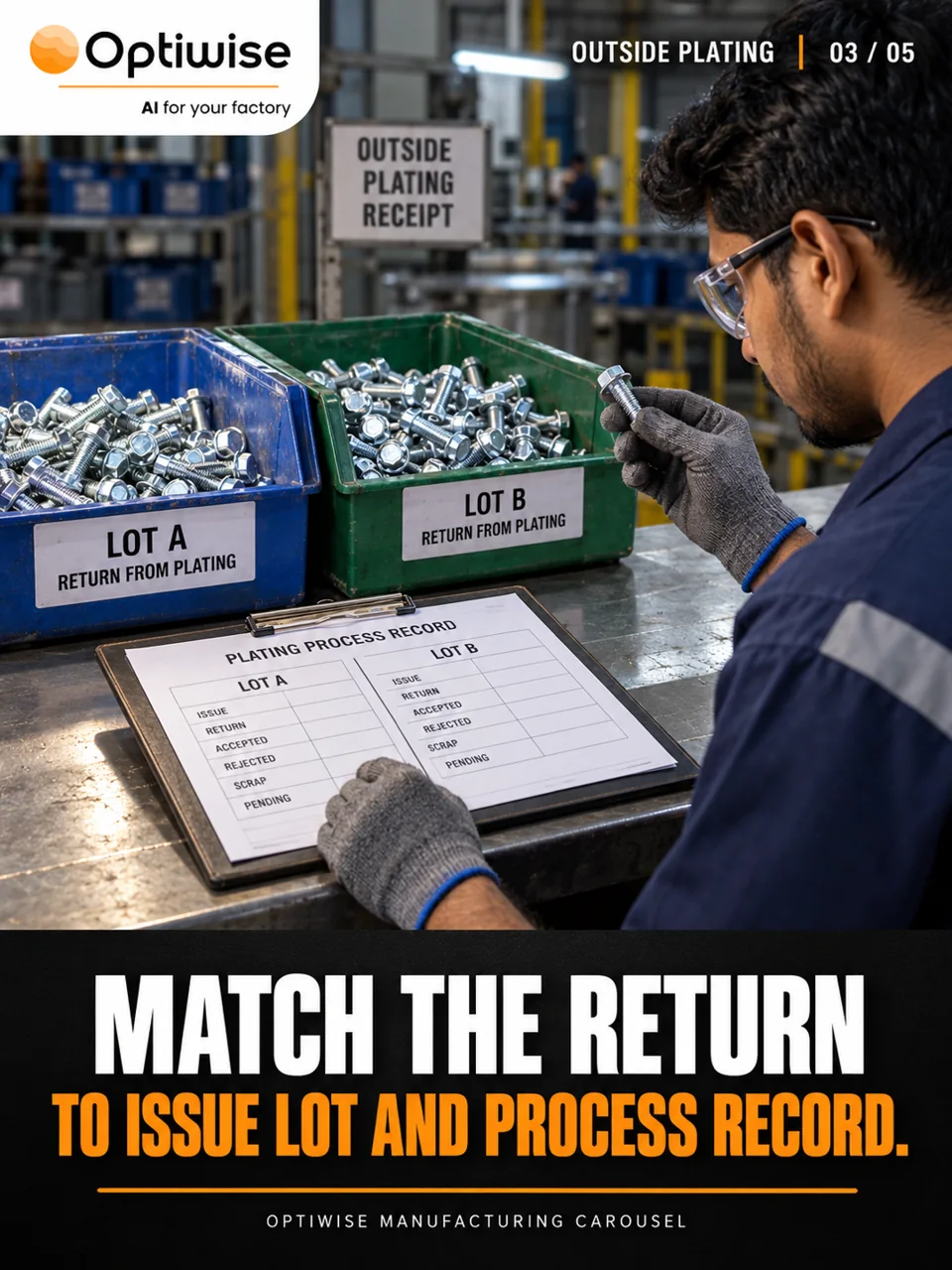
Agree how lot identity will travel to the plater and back
Record the part and revision, source lot, quantity, unit, service order and delivery challan for each dispatch line. Keep the coating specification and required process or test documents connected to the outside work. Agree with the plater how containers will be identified and how partial returns will refer to the original lot.
Packaging and identification must suit the actual process. A label on a dispatch bag does not establish that identity survives every treatment or repacking step. The processor needs an agreed way to keep the lots distinguishable and report any split, mix or loss of identification before return.
GS1's traceability guidance explains the need to capture and share information as goods move between partners. C&R Plating's published quality clauses provide one processor's example of requiring lot or batch identification on material and its documents. For your workflow, retain the link from the material sent to the material returned, together with who handled it, where and when. Your customer's requirements determine the applicable evidence and acceptance rules.
Reconcile the return one lot at a time
Consider an illustrative one-piece-to-one-piece process: each fastener sent becomes one plated fastener. Lot A contains 600 pieces and Lot B contains 400. The first return has 500 pieces from Lot A and 300 from Lot B. The processor's lot identities are intact, and stores counts the two lots separately.
| Lot | Sent / returned | Still with plater |
|---|---|---|
| A | 600 / 500 pieces | 100 pieces |
| B | 400 / 300 pieces | 100 pieces |
| Total | 1,000 / 800 pieces | 200 pieces |
Quality accepts 480 of the 500 returned Lot A pieces and rejects 20. All 300 returned Lot B pieces await inspection. You now have 800 pieces physically back, 480 accepted, 20 rejected and 300 awaiting inspection. The 300 and 20 are already included in the 800 returned; subtracting them again would distort the outside balance.
The plater still holds 200 pieces. Quality has a separate decision on the 320 returned pieces that are not accepted stock. Stores needs the first balance to chase material; production needs the second to decide whether enough usable fasteners are available.
Keep this arithmetic within one item and unit. If the outside operation combines several materials or changes the unit, reconcile the actual input relationship instead of subtracting finished pieces from kilograms issued.
Record a rejected return sent back for rework
Suppose the 20 rejected Lot A pieces go back to the plater. Record the new dispatch with the original lot and rework reference. Lot A's outside balance becomes 120 pieces: the previous 100 plus the 20 sent back. Lot B remains at 100, so the total outside balance becomes 220.
Do not edit the first receipt down from 500 to 480. It really contained 500 pieces. The later rework dispatch explains why 20 left again. When those 20 return, record the new inward and inspection result before accepting them. This preserves the first failure, the corrective work and the final decision.
A claimed scrap quantity also needs its actual location and agreed disposition. Scrap still held at the vendor is different from scrap physically returned. An unexplained shortage should remain a shortage with an assigned follow-up; adding a scrap line merely to force the balance to zero removes the problem from view.
Hold a mixed return while the identity question is resolved
If the first 800 pieces arrive mixed, record the physical arrival and the identification problem. Keep them segregated from stock eligible for the next job while the responsible quality team determines the disposition. Record the vendor's supporting process and packaging evidence alongside the receiving exception.
Do not invent a 500/300 split from the numbers expected on the order. A matching total does not reconstruct the physical lots. The quality decision may require further evidence, an approved identification method, retesting, rework or rejection under the customer's specification. ERP records keep that decision visible; software cannot recover an identity that the physical process failed to preserve.
Purchasing should ask the plater to resolve the specific missing link, with an owner and due date. Production should plan from the accepted stock that can be identified, rather than assuming that all material at the receiving gate is ready.
Run the outside-work handoff in Optiwise
Create the subcontract service order for the vendor and operation. Use the linked delivery challans for the material you send, including partial or extra issues. On return, record the inward and goods receipt, then follow the configured inspection path. Our subcontracting workflow retains the service timeline and vendor-held material balance.
Use inventory identifiers and movement history to connect the source material with each dispatch and receipt. We configure the lot-reference fields, container details and required forms around your processor's handoff. Your receiving and quality teams must still preserve the physical separation and provide the agreed inspection evidence. The quality queue keeps the result connected to the relevant operational record.
Close the material balance when every quantity has a recorded destination or authorised disposition, and retain open quality actions until they are resolved. Service invoices and payments follow their commercial records. A settled invoice cannot establish that all issued material returned or that every returned part passed inspection.
Questions about plating returns
Can we release a return when the quantity is correct but the lot is unknown?
Keep it out of usable stock until the responsible quality team resolves the missing identity under the customer's requirements. Record the physical receipt and exception without inventing a lot allocation.
Do rejected parts count as still with the plater?
Only if they are physically there. Rejected parts already received are part of the returned quantity. A later rework dispatch creates a new outward movement and increases the relevant vendor balance.
Can Optiwise track partial returns and extra material issues?
Yes. We connect subcontract service orders, partial and extra material dispatches, vendor-held balances, returned goods and quality records. The lot fields and processor handoff are configured for your workflow.
Bring an outside-plating order, two source lots and a partial return to an Optiwise walkthrough. We will map the material balance, inspection decision and rework movement. We charge ₹0 for implementation; subscription, optional add-ons and IoT hardware are separate.
Related Posts
Cable Drum Inventory: Promise One Continuous Length
Track cable by drum before promising an unjointed length. Work through allocation, cut losses, usable remainders and the Optiwise stock handoff.
26 Oct 2026Read more →
Fabric Shade Groups: Allocate Rolls to a Cutting Lay
Allocate fabric rolls to cutting lays with shade-group approval, usable-length checks and remnant identity. Includes a two-group worked allocation example.
30 Sept 2026Read more →Powder Coating Reclaim: Keep Each Blend Traceable
Build a powder-coating reclaim record with parent lots, approved blend rules, mass reconciliation and job links. Includes a clearly illustrative balance example.
30 Sept 2026Read more →
Torque Tool Job Changes: Record the Approved Setting
Use a torque-tool job-change record to connect joint revision, units, tool identity, setup verification and the first affected assembly without inventing settings.
30 Sept 2026Read more →