
How Do Factories Actually Use AI on the Factory Floor?
See practical ways factories use AI on the shopfloor, from production monitoring and quality alerts to maintenance, inventory, planning, and supervisor support.

How Do Factories Actually Use AI on the Factory Floor?
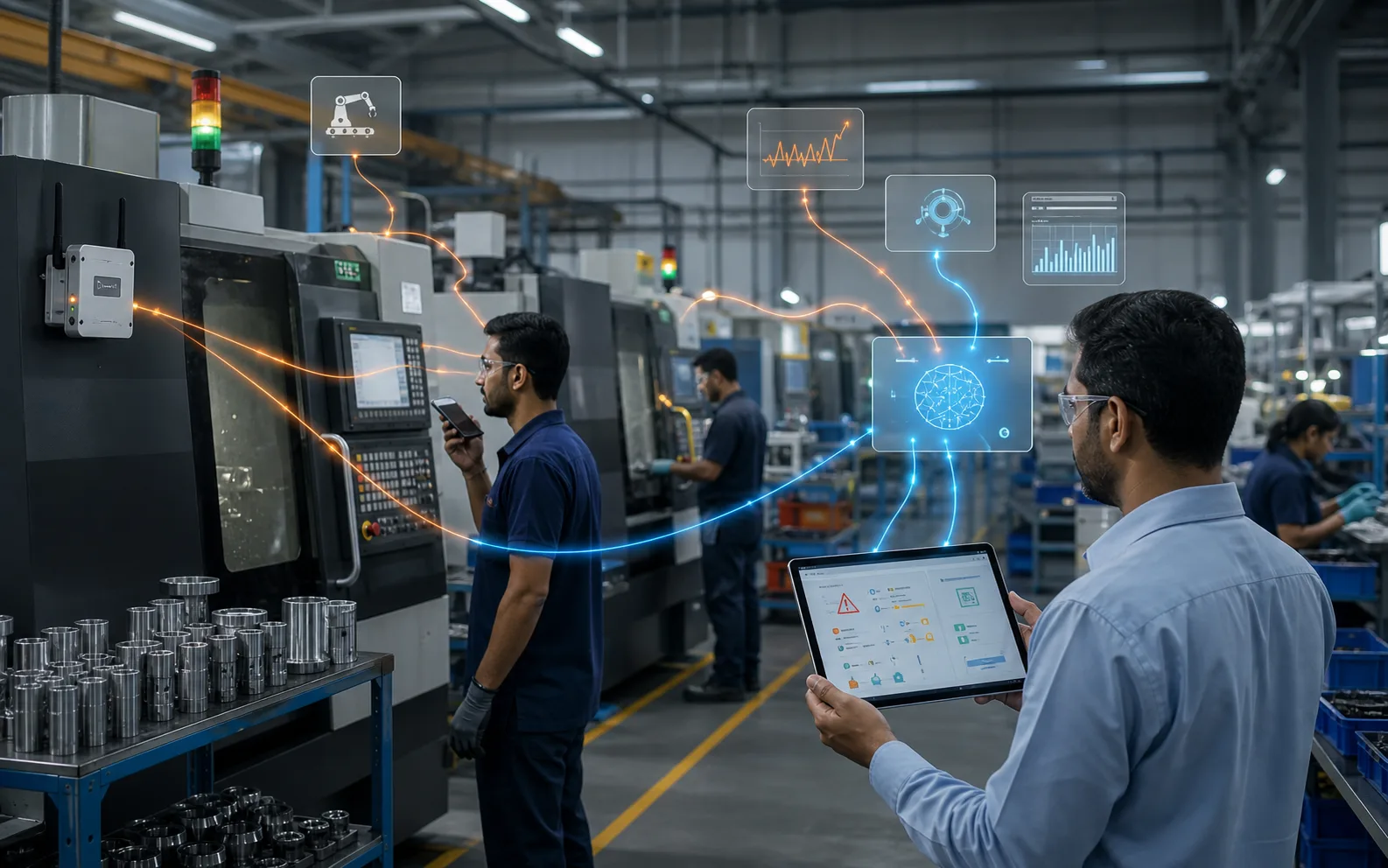
On the factory floor, AI is most useful when it helps people notice problems earlier and make decisions faster. It does not need to look futuristic. In many factories, practical AI appears as alerts, dashboards, recommendations, summaries, and exception reports.
The shopfloor is where manufacturing reality happens. Machines run, materials move, workers coordinate, quality issues appear, and production plans meet actual conditions. AI helps when it connects this reality with timely information.
Production Monitoring
AI can compare planned output with actual progress and highlight when a job is falling behind. Supervisors can see which work orders need attention and whether the issue is material, machine, quality, or manpower related.
This helps teams respond during the shift instead of waiting for end-of-day reports.
Quality Alerts
AI can track defect patterns, rejection reasons, rework frequency, and inspection data. If a defect starts repeating, the system can alert quality teams earlier.
This is useful because quality problems often become expensive when they travel downstream. Early visibility reduces rework and customer risk.
Maintenance Risk Signals
On the shopfloor, maintenance issues often show up as small warnings before full breakdowns. AI can support teams by identifying machines with repeated stoppages, rising downtime, unusual spare usage, or patterns linked to previous failures.
Technicians still diagnose the problem, but AI helps decide where to look first.
Material Availability
AI can warn production teams when material availability may affect upcoming jobs. It can connect stock, purchase orders, consumption, and planned production so supervisors are not surprised at the last moment.
This is especially important when multiple products share common materials.
Shift and Supervisor Support
AI can summarize shift performance, pending issues, delayed jobs, quality holds, and urgent approvals. This helps supervisors hand over work more clearly between shifts.
A good shift summary reduces dependency on memory and informal messages.
Practical Examples Without Overcomplication
A factory may use AI to flag that a work order is behind schedule by 18 percent. Another may use AI to show that one machine has caused three similar stoppages in two weeks. Another may use AI to identify a material that will run short before the next production batch.
These are not dramatic examples. They are useful because they help people act.
Where AICAN Optiwise Fits
AICAN Optiwise helps bring shopfloor activity into connected business workflows. Production, inventory, purchase, sales, finance, and reporting visibility allows AI insights to connect with real decisions.
AICAN supports manufacturers who want practical factory-floor intelligence, not disconnected dashboards. Learn more at About AICAN.
Founder’s Note
AI on the factory floor should feel like better visibility, not extra noise. Workers and supervisors already have enough pressure.
The right system tells them what needs attention, why it matters, and what action is possible. That is how AI becomes useful inside the actual rhythm of production.
FAQ
Do factories need robots to use AI?
No. AI can support reporting, planning, maintenance, inventory, and quality without robotic automation.
Can AI work with shopfloor teams?
Yes, especially when insights are simple, timely, and connected to existing responsibilities.
What is a common factory-floor AI use case?
Production delay alerts, quality trend detection, machine risk signals, and material shortage warnings are common practical use cases.
Does AI replace supervisors?
No. It supports supervisors with faster visibility and better summaries.
Final Thought
Factories use AI best when it helps the shopfloor see what is changing, what is at risk, and what needs action. Practical AI is less about spectacle and more about timely decisions.

Related Posts
Is AI Worth the Investment for My Factory?
Learn how to decide if AI is worth the investment for your factory by evaluating use cases, data readiness, costs, risks, ROI, and operational impact.
13 Jun 2026Read more →Manufacturing AI Mistakes to Avoid Before You Start
List manufacturing AI mistakes and controls for unclear use case, messy data, unsafe automation, no owner, weak security and unreviewed recommendations.
13 Jun 2026Read more →What's the Difference Between AI and Regular Automation?
Understand the difference between AI and regular automation in manufacturing, with practical examples for workflows, decisions, alerts, and predictive operations.
13 Jun 2026Read more →What Are the Risks of Using AI in Manufacturing?
Understand the risks of AI in manufacturing, including bad data, wrong recommendations, safety issues, security, job fear, over-automation, and implementation failure.
13 Jun 2026Read more →