
How Much Will AI Manufacturing Solutions Cost My Company?
Learn what AI manufacturing solutions cost, including software, implementation, integration, sensors, data cleanup, training, support, and ROI planning.

How Much Will AI Manufacturing Solutions Cost My Company?
The cost of AI manufacturing solutions depends on the use case. A simple AI tool for SOPs and report summaries may be inexpensive. AI connected to ERP, machines, sensors, quality systems, and production planning will cost more because it requires implementation, integration, training, and support.
The right way to evaluate cost is to compare it with the operational problem being solved.
Cost Level 1: Simple AI Tools
Simple AI tools can help with:
- SOP creation
- Training material
- Report summaries
- Vendor emails
- Customer updates
- Meeting notes
- Basic spreadsheet review
These tools are usually the lowest-cost starting point. They may not need heavy integration, but they do need data policy and human review.
Cost Level 2: ERP-Connected AI
ERP-connected AI costs more because it works with real operational data.
It may support:
- Inventory insights
- Production delay summaries
- Purchase risk alerts
- Quality issue analysis
- Dispatch visibility
- Management dashboards
- Finance visibility
Costs may include configuration, user roles, data access, security, and training.
Cost Level 3: Machine and IoT AI
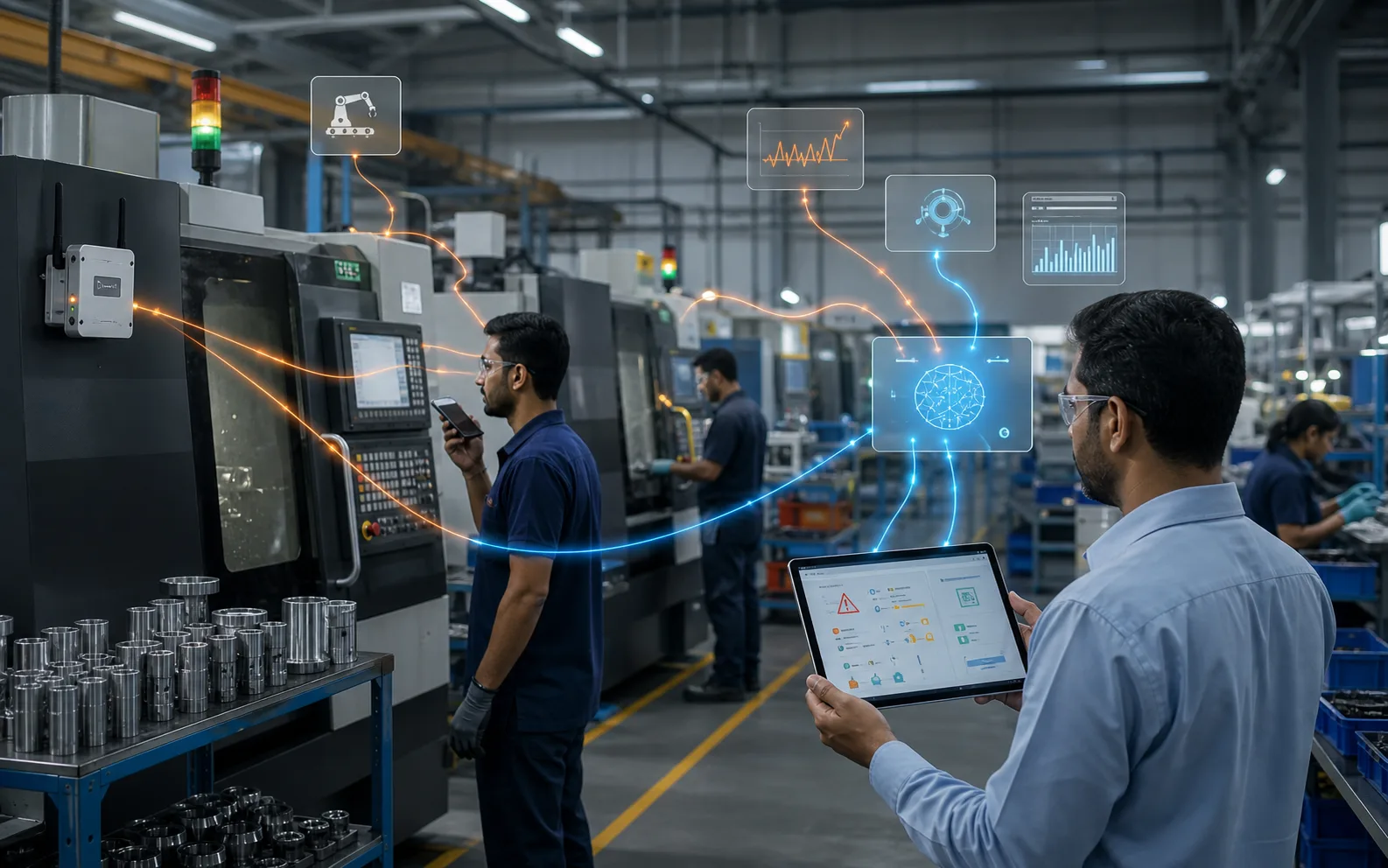
AI for machine monitoring, predictive maintenance, vibration, temperature, and energy analysis may require sensors, gateways, dashboards, and data pipelines.
This increases cost but can create strong ROI if downtime is expensive.
Cost Level 4: Advanced AI Systems
Advanced AI can include computer vision inspection, custom forecasting, optimization, and multi-plant analytics.
These projects may need specialists, custom models, labeled data, and longer validation.
Hidden Costs to Include
Do not budget only for software subscription.
Include:
- Data cleanup
- Process mapping
- Integration
- User training
- Security review
- Go-live support
- Change management
- Maintenance and updates
- Internal time from teams
These costs often decide whether implementation succeeds.
How to Control Cost
Start with one use case. Run a pilot. Measure value. Expand only if the result is useful.
Avoid buying advanced AI before the factory has data readiness and user adoption.
ROI Matters More Than Price
A low-cost AI tool that nobody uses is expensive. A higher-cost system that reduces downtime, defects, inventory waste, or manual reporting may pay for itself.
Cost should always be evaluated against measurable outcomes.
Where AICAN Optiwise Fits
AICAN Optiwise helps MSME manufacturers access AI inside connected ERP and manufacturing workflows. It combines sales, purchase, inventory, production, shopfloor, quality, dispatch, finance visibility, reports, IoT readiness, and AI agents.
This reduces the need for disconnected tools and helps manufacturers connect AI cost with operational ROI.
Learn more at AICAN Optiwise and About AICAN.
Founder’s Note
AICAN’s view is that AI pricing should make sense for real manufacturers, especially MSMEs. Technology should not feel like a luxury experiment.
Optiwise is built to connect AI with the workflows where value appears, so cost can be judged against better visibility, fewer delays, and stronger control.
FAQ
Is AI expensive for manufacturers?
It depends on the use case. Simple AI is affordable; advanced machine-connected AI costs more.
What hidden costs should I expect?
Data cleanup, integration, training, security, support, and process change.
Should small manufacturers start with custom AI?
Usually no. Start with practical tools or AI-enabled ERP.
How do I know if the cost is worth it?
Measure time saved, downtime reduced, defects reduced, inventory improved, or faster decisions.
Can AI cost be phased?
Yes. Start with a pilot and expand based on ROI.
Final Thought
AI manufacturing solution cost should be tied to business value. Start small, measure results, and invest deeper only where AI solves a real operational problem.
Next step: Explore AICAN Optiwise if your company wants AI connected to manufacturing ERP workflows with practical ROI.

Related Posts
Is AI Worth the Investment for My Factory?
Learn how to decide if AI is worth the investment for your factory by evaluating use cases, data readiness, costs, risks, ROI, and operational impact.
13 Jun 2026Read more →Manufacturing AI Mistakes to Avoid Before You Start
List manufacturing AI mistakes and controls for unclear use case, messy data, unsafe automation, no owner, weak security and unreviewed recommendations.
13 Jun 2026Read more →What's the Difference Between AI and Regular Automation?
Understand the difference between AI and regular automation in manufacturing, with practical examples for workflows, decisions, alerts, and predictive operations.
13 Jun 2026Read more →What Are the Risks of Using AI in Manufacturing?
Understand the risks of AI in manufacturing, including bad data, wrong recommendations, safety issues, security, job fear, over-automation, and implementation failure.
13 Jun 2026Read more →