
Hydraulic Oil Sample Register: Preserve Machine and Sample Context
Keep hydraulic oil analysis traceable with a sample-context register covering machine identity, sample point, hours, top-ups, report matching and exceptions.

Give each hydraulic oil sample a unique identity linked to its machine, compartment, sample point, collection time and recent operating history. Match the laboratory report to that record before comparing trends or assigning a maintenance action.
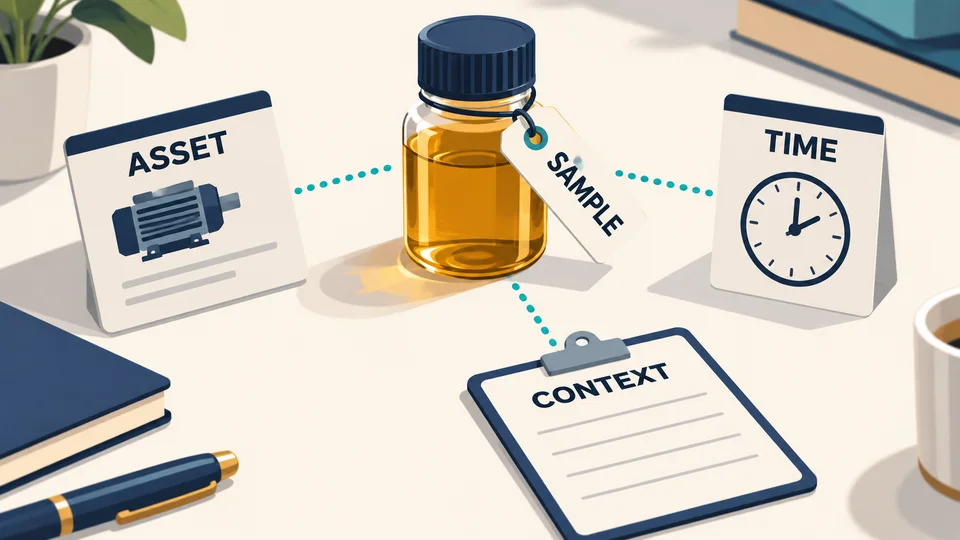
A laboratory report can be precise and still reach the wrong maintenance decision if the bottle was assigned to the wrong machine. A sample taken after a recent top-up also has a different history from one taken before it. Keep the context with the result.
Prepare the record before collection
The maintenance planner owns the register with the authorised sampler and the laboratory contact. Start when a routine sample is due, an abnormal condition needs investigation or the sampling point changes. Bring the machine and compartment identities, the approved sampling method, lubricant record, previous sample and laboratory submission requirements.
Caterpillar's fluid-analysis guidance explains the value of routine sampling and clean samples. Follow the applicable OEM and laboratory procedure for physical collection. The record below does not authorise opening a pressurised system or changing an equipment isolation procedure.
| Record group | Fields to retain |
|---|---|
| Identity | Sample ID, machine ID, compartment and lubricant product |
| Collection | Date, time, authorised sampler, approved point and method |
| Operating context | Machine hours, hours on oil where known and operating condition required by the procedure |
| Intervening events | Oil change, top-up, filter change, repair or abnormal observation |
| Submission | Bottle label, request reference, requested tests and dispatch details |
| Result | Laboratory sample reference, report version and receiving reviewer |
| Decision | Action, responsible maintenance role, due date and closure evidence |
Unknown hours should remain unknown. A guessed value creates false continuity in the trend. Record a changed meter, unavailable history or changed sampling point explicitly so the analyst can decide how to interpret the comparison.
Keep a top-up visible in the history
Illustrative scenario: machine H-07 was sampled at 1,000 recorded operating hours. A second sample is taken at 1,250 hours. The interval is 250 operating hours. The register also shows a six-litre top-up at 1,230 hours, 20 hours before the second sample.
Those facts belong with the laboratory request and report. They do not quantify dilution or prove that the oil is acceptable. The authorised analyst needs the lubricant, compartment and intervention context before comparing the results. Preserve the previous report even if the new result appears better.
If a machine has more than one reservoir, give each compartment its own identity and sample history. “Hydraulic oil, press line” is too broad if it can refer to several systems. A new bottle should receive a new sample ID even when a repeat is requested after an uncertain result.
Resolve identity errors before interpreting numbers
At dispatch, compare the label and submission record. On receipt of the report, match the laboratory reference, machine, compartment and collection date. If they conflict, mark the result pending identity reconciliation and contact the responsible laboratory or sampling owner through the normal process.
Do not silently edit the sample date to match the report. Preserve the original submission, the correction and who confirmed it. If reliable identity cannot be recovered, the responsible specialist decides whether a new sample is needed. A convenient reassignment can contaminate two machines' histories at once.
Assign the maintenance response and verify closure
The reviewer should record the laboratory recommendation and the action authorised for the equipment. Keep interpretation separate from execution: “report reviewed” does not mean a maintenance task was completed. Link any subsequent work and repeat sampling to the original finding.
For a pilot, inspect ten consecutive sample records. Each must match a bottle/submission reference and a report, or have a named unresolved exception. Count missing context fields and reports awaiting a decision. Accept the register when every result is traceable and every required action has an owner; no universal wear-metal or cleanliness threshold is supplied here.
Our Optiwise custom modules support related records and role-based forms. Configure the sample register around your machine and maintenance references, with the report attached to the right sample. This is a record workflow, not an automatic lubricant diagnosis.
Oil-sample record questions
Can a repeat sample reuse the first sample ID?
Use a separate identity for the new collection and link it as a repeat. The two bottles have different collection events even if they answer the same question.
What if the sample point changes?
Record the new point and the reason, then flag the change for the analyst. Do not assume a trend remains directly comparable under changed sampling conditions.
Bring one oil-sample submission and report to an Optiwise workflow demo.
Related Posts

Fabric Shade Groups: Allocate Rolls to a Cutting Lay
Allocate fabric rolls to cutting lays with shade-group approval, usable-length checks and remnant identity. Includes a two-group worked allocation example.
30 Sept 2026Read more →Powder Coating Reclaim: Keep Each Blend Traceable
Build a powder-coating reclaim record with parent lots, approved blend rules, mass reconciliation and job links. Includes a clearly illustrative balance example.
30 Sept 2026Read more →
Torque Tool Job Changes: Record the Approved Setting
Use a torque-tool job-change record to connect joint revision, units, tool identity, setup verification and the first affected assembly without inventing settings.
30 Sept 2026Read more →
Opened Adhesive Containers: Record Dates Before Reissue
Track partially used adhesive containers with opening dates, supplier limits, storage exceptions and an issue-return worksheet. Avoid invented expiry extensions.
30 Sept 2026Read more →