
Optiwise vs Odoo Inventory: Stock Connected to Your Factory
Compare Odoo Inventory and Optiwise for manufacturing stock. Connect stores, material demand, quality, purchasing and production in Optiwise.
Manage raw materials, work in progress and finished goods in Optiwise. We connect stock to the production order, purchase requirement and quality decision so your team knows what is available and what needs action. Get inventory, manufacturing execution, industrial IoT, AI agents and no-code workflows in one factory platform.
Odoo Inventory combines inventory and warehouse management. Optiwise puts manufacturing demand and stock movement in the same daily workflow, from a material shortage through purchase, inspection, issue and finished-goods receipt.
Book an Optiwise demo · Explore Optiwise inventory
Optiwise and Odoo Inventory at a glance
| Your workflow | Optiwise | Odoo Inventory |
|---|---|---|
| Stock locations | Control raw material, WIP and finished goods across stores. Track variants, UOM conversions, batches and barcodes; manage issue/receipt/transfer requests and generate reorder indents from minimum/maximum levels. | Warehouses, locations and stock transfers. |
| Replenishment | Turn shortages into work. Smart Suggest nets BOM demand against stock, open purchase orders and existing production. Create the in-house jobs, purchase indents and subcontract orders your team needs from the resulting plan. | Reordering rules and replenishment reports. |
| Traceability | Follow batches and barcodes through receipts, store transfers and production issues. Keep the material movement attached to the relevant order, inspection and stock record for a traceable factory workflow. | Lots, serial numbers and movement history. |
| Consumption | Issue materials by order or in bulk, record output-based consumption and extra issues, and receive finished goods after inspection. Apply configured UOM conversions and FIFO, LIFO or expiry-based consumption policies. | Removal strategies including FIFO, LIFO and FEFO. |
Product references: Odoo Inventory. Updated 10 September 2026.
Manufacturing inventory, backed by AI and IoT
AI for the work behind the stock balance
Ask your inventory agent for stock information or give a natural-language instruction to record received material. Optiwise connects the action to your operating records and role permissions, with multilingual access for the stores team.
Inventory connected to a live factory
Run stock, purchasing and production in the same platform as industrial IoT. Monitor machine runtime, downtime, OEE and energy alongside the workflows that consume material and produce finished goods. Move from a stock view to the manufacturing context behind it.
Controls that fit your materials
Configure item variants, multiple units of measure, batch rules and reorder levels. Add custom inspection forms, fields, linked modules and automated actions without code, instead of forcing every material and store into one generic process.
Explore Optiwise AI agents · Explore industrial IoT · Explore no-code customization
Why choose Optiwise for your factory
Plan purchases against the work you have promised
Set reorder levels for routine replenishment. For a production order, Smart Suggest considers the BOM, stock, existing production and pending purchases. Buyers receive the resulting indents instead of rebuilding the factory requirement from separate stock exports.
Keep inspection between receipt and availability
Receive material against the purchase order, send it through the configured item inspection and release accepted quantities into stock. Track rejected returns and remaining supplier quantities separately. Store teams can follow the receipt, quality decision and issue in one workflow.
Work with manufacturing item detail
Maintain variants, multiple units of measure, drawings, vendor terms and store-level thresholds in the item master. Use stock-aging and low-stock dashboards for review, and ask Rishabh, our inventory AI agent, about the underlying records.
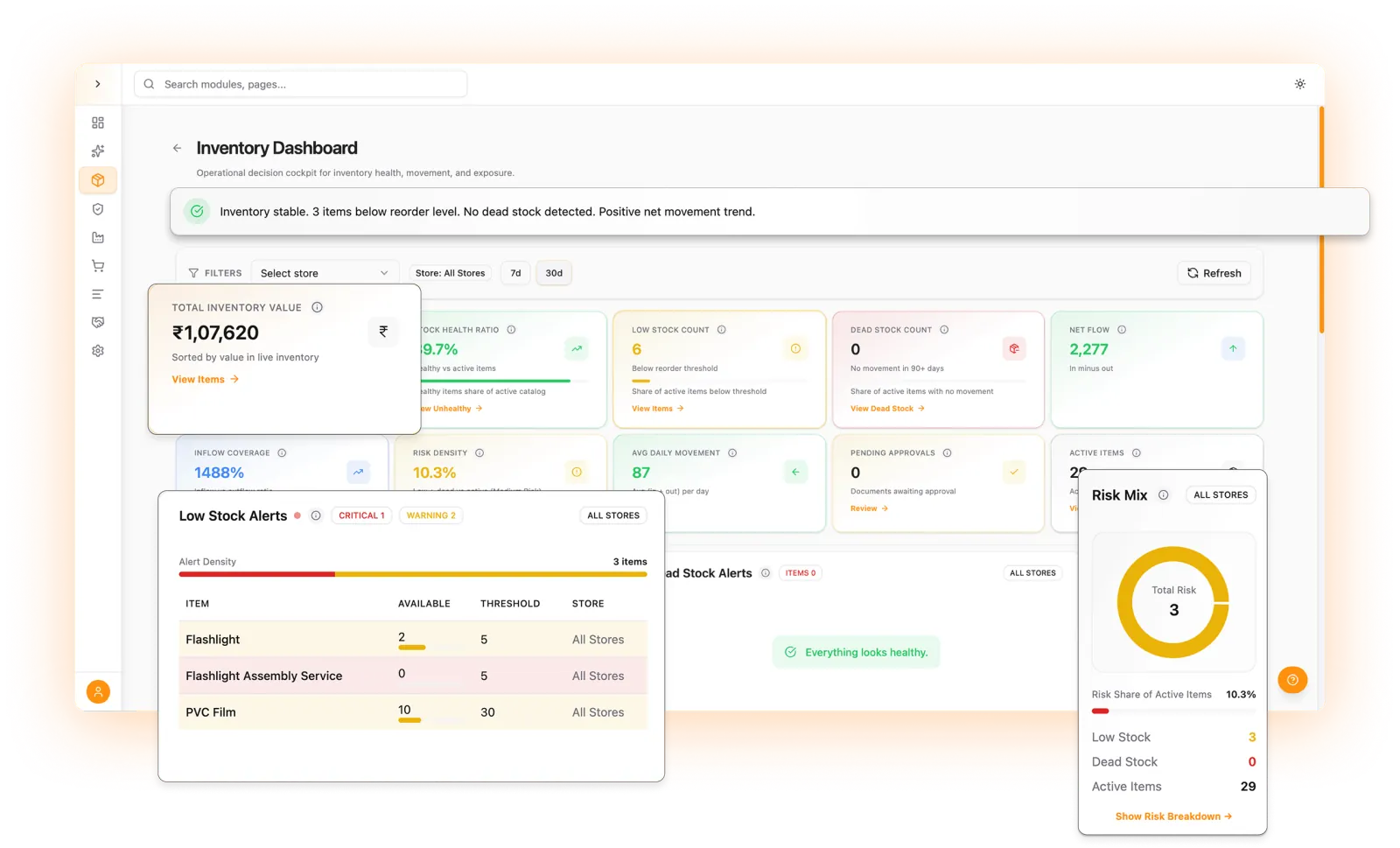
See your factory workflow in Optiwise
Bring your product, process and team requirements. We’ll walk you through the connected material and stock workflow and map it to your factory.
Book your Optiwise demo · Meet your AI agents · Explore no-code workflows
Questions about Odoo Inventory and Optiwise
Can Optiwise connect inventory with production?
Yes. Material demand, issue, consumption and finished-goods receipt connect to production orders. Smart Suggest also considers existing stock and pending supply when calculating action quantities.
Does Optiwise support multiple stores and units of measure?
Yes. Maintain stock across stores, transfer material between them and use configured unit conversions for item transactions.
Does Optiwise include industrial IoT and AI?
Yes. Optiwise combines manufacturing ERP and shop-floor execution with industrial IoT and specialized AI agents. Connect machines through gateways and sensors, track OEE, downtime and energy, and use natural-language queries and actions across production, purchasing, inventory, sales and tasks. No-code modules and automations let you extend the workflow.
Related Posts

Will AI Replace My Procurement Job?
AI will change procurement work, but it is more likely to automate repetitive tasks than replace procurement professionals who build supplier judgment and strategy.
14 Jun 2026Read more →Cloud Procurement | Optiwise
Learn cloud procurement for SMEs and manufacturers, including purchase requests, approvals, supplier follow-up, inventory linkage, and how AICAN Optiwise improves control.
12 Jun 2026Read more →Benefits Of Inventory Management | Optiwise
Learn the benefits of inventory management for SME manufacturers, including stock accuracy, lower working capital blockage, fewer stockouts, better production planning, and dispatch control.
9 Jun 2026Read more →Automated Inventory Management System | Optiwise
Learn how automated inventory management systems help manufacturers improve stock accuracy, low-stock alerts, warehouse control, material planning, and reporting.
7 Jun 2026Read more →