
What Can a Five-User Factory Save With Optiwise Digitize?
See a five-user Digitize example: 65 hours of team time worth ₹8,750 monthly, software costs, break-even minutes and a practical order-to-material workflow.


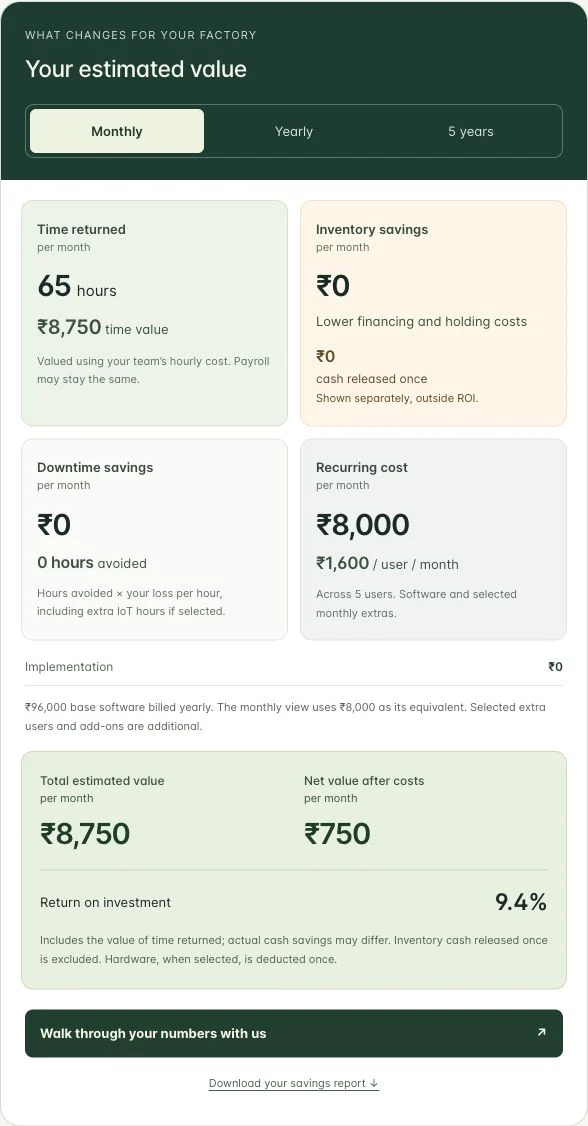
Our Digitize plan connects the work of five core factory users. In this editable time-only example, 65 hours returned each month are worth ₹8,750 against an ₹8,000 monthly software equivalent on yearly billing.
We recommend Digitize when your first job is to get sales, buying, stores, production and quality working from connected records. Start with one order that keeps generating calls. The useful saving is the work your people stop repeating: finding the latest quotation, checking a material balance or asking whether an inspection is complete.
Follow one order instead of five separate updates
Take an illustrative order for 100 valve assemblies. It needs 100 housings. Your stores record shows 60 usable housings, 20 awaiting inspection and 20 still due from the supplier. A message saying “we have 80” hides the decision production needs: only 60 are currently usable.
In Optiwise, your sales user keeps the quotation and order context. Your buyer follows the outstanding purchase quantity. Stores records what arrived, while the inspection outcome controls the relevant stock release. Your supervisor follows production and the remaining material need. The owner can trace the question back to those records instead of collecting a new explanation from each person.
If the 20 held housings fail inspection, they must not become usable simply because the order is urgent. Keep the inspection outcome and replacement requirement visible, then decide what can be produced now and what still needs buying. Our inventory workflow and production records connect that decision to the actual material and job.
What 30 minutes a day is worth for five people
This example uses four office users and one manager, all within Digitize’s five included main users. Each gets back 30 minutes per working day. We use 26 days of eight hours, a monthly employment cost of ₹25,000 for each office user and ₹40,000 for the manager. These are editable example inputs, not salary benchmarks or customer results.
| People | Hours returned | Time value |
|---|---|---|
| Four office users | 52 | ₹6,250 |
| One manager | 13 | ₹2,500 |
| Total | 65 | ₹8,750 |
The hourly cost is monthly employment cost divided by 208 working hours. Across the five users, the estimate averages ₹1,750 in time value per person per month. Time returned could go into answering enquiries, preparing the next job or completing purchasing sooner. Payroll does not automatically fall by that amount.
Compare that value with the full software cost
Digitize is ₹96,000 billed yearly, equivalent to ₹8,000 a month or ₹1,600 per included user per month. Monthly billing is ₹9,600, or ₹1,920 per included user per month. Our pricing page shows the plan’s current scope. Optiwise implementation costs ₹0; selected add-ons, hardware and applicable taxes are separate.
Against yearly billing, ₹8,750 of monthly time value leaves ₹750 after the software equivalent. Twelve identical months give ₹1,05,000 of time value against ₹96,000 software, leaving ₹9,000. The calculator’s five-year view repeats the same inputs for 60 months: ₹5,25,000 time value against ₹4,80,000 software, leaving ₹45,000. That longer view assumes unchanged work and prices; it is not a forecast.
On monthly billing, this same time-only example is ₹850 below the ₹9,600 subscription each month. Use the comparison honestly. Add an inventory, overtime or other operating saving only when you have a separate basis for it. Do not count the same follow-up minutes twice.
Find the minutes you can actually remove
With these salaries and working days, about 27.4 minutes returned per person per day matches the yearly subscription’s monthly equivalent. Monthly billing needs about 32.9 minutes. This threshold values work capacity; it is not a cash-payback promise.
Choose a few comparable orders. Note the person, order reference, repeated task and time spent: finding a quotation version, checking usable material, following a supplier or reconstructing job status. After the team uses the connected records, observe the same tasks and include any time spent correcting missing entries. A screen opened is not a completed handoff.
The US National Institute of Standards and Technology explains how mapping office work and its handoffs helps reveal delays and redundant steps. That supports the measurement method here; it does not establish a saving for Optiwise.
Try the five-user case with your own figures
Open the Digitize savings calculator. Digitize and yearly billing are preselected. Set average inventory and unplanned downtime to zero to reproduce this time-only example, then adjust salaries and minutes under the time assumptions. The full calculator starts with other editable factory assumptions, so those two changes matter.
Digitize includes five main users. This example adds no separate shop-floor seats and no optional AI or IoT costs. Keep the people who actually enter records inside your selected user scope; a supervisor entering production data is different from giving every operator a separate account.
Are AI agents included in the Digitize base plan?
AI agents are listed as an optional add-on for Digitize. The time-only calculation here uses the core record workflow and includes no assumed AI-agent benefit or add-on charge.
What if we need more than five main users?
The published Digitize plan lists additional main users at ₹1,000 per user per month. Enter your actual users and selected extras in the calculator, and use your quote for the complete scope and taxes.
Book a Digitize walkthrough with one order, its material exception and a few real follow-up timings. We can show how your five core users finish the work in Optiwise.
Related Posts
Optiwise Scale Savings: Build the Case for a 100-User Team
Build a realistic Scale business case for 50 main and 50 shop-floor users. Compare full, half and quarter time-return scenarios, costs and shift handoffs.
2 Nov 2026Read more →
Wait for Cheaper Software or Start a Focused Factory Rollout?
Compare a defined first workflow with the recorded cost of waiting. Optiwise implementation costs ₹0; recurring software, add-ons and devices remain separate.
9 Jun 2026Read more →MSME networking events and trade fairs 2024: International opportunities for Indian businesses
Written by Reading progress Call us As we step into 2024, the landscape for Micro, Small, and Medium Enterprises (MSMEs) is evolving rapidly. With digital transformation becoming the norm, it’s crucial for Indian busines…
17 Apr 2026Read more →
Circular Design Principles for MSME Products: From Concept to Consumer
Written by Reading progress Call us As we step into 2024, the landscape for Micro, Small, and Medium Enterprises (MSMEs) is evolving rapidly. With digital transformation becoming the norm, it’s crucial for Indian busin I…
28 Oct 2025Read more →