
Optiwise Scale Savings: Build the Case for a 100-User Team
Build a realistic Scale business case for 50 main and 50 shop-floor users. Compare full, half and quarter time-return scenarios, costs and shift handoffs.

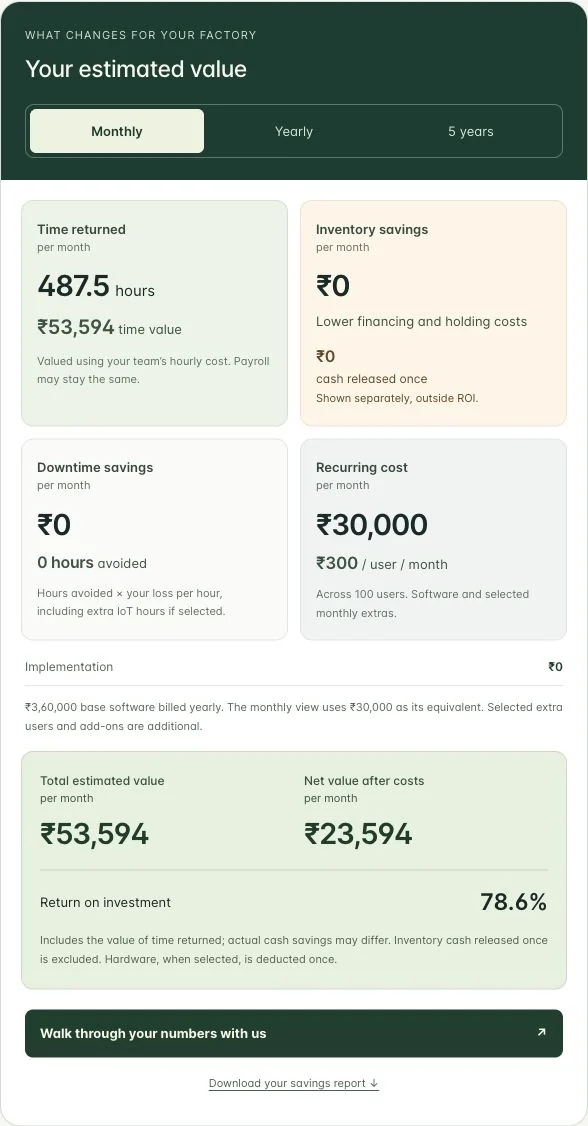
Our Scale plan includes 50 main users and 50 shop-floor users. An example using half the starting time assumptions gives 487.5 team hours worth ₹53,593.75 per month against a ₹30,000 software equivalent on yearly billing. The case depends on work actually changing, not seats simply being available.
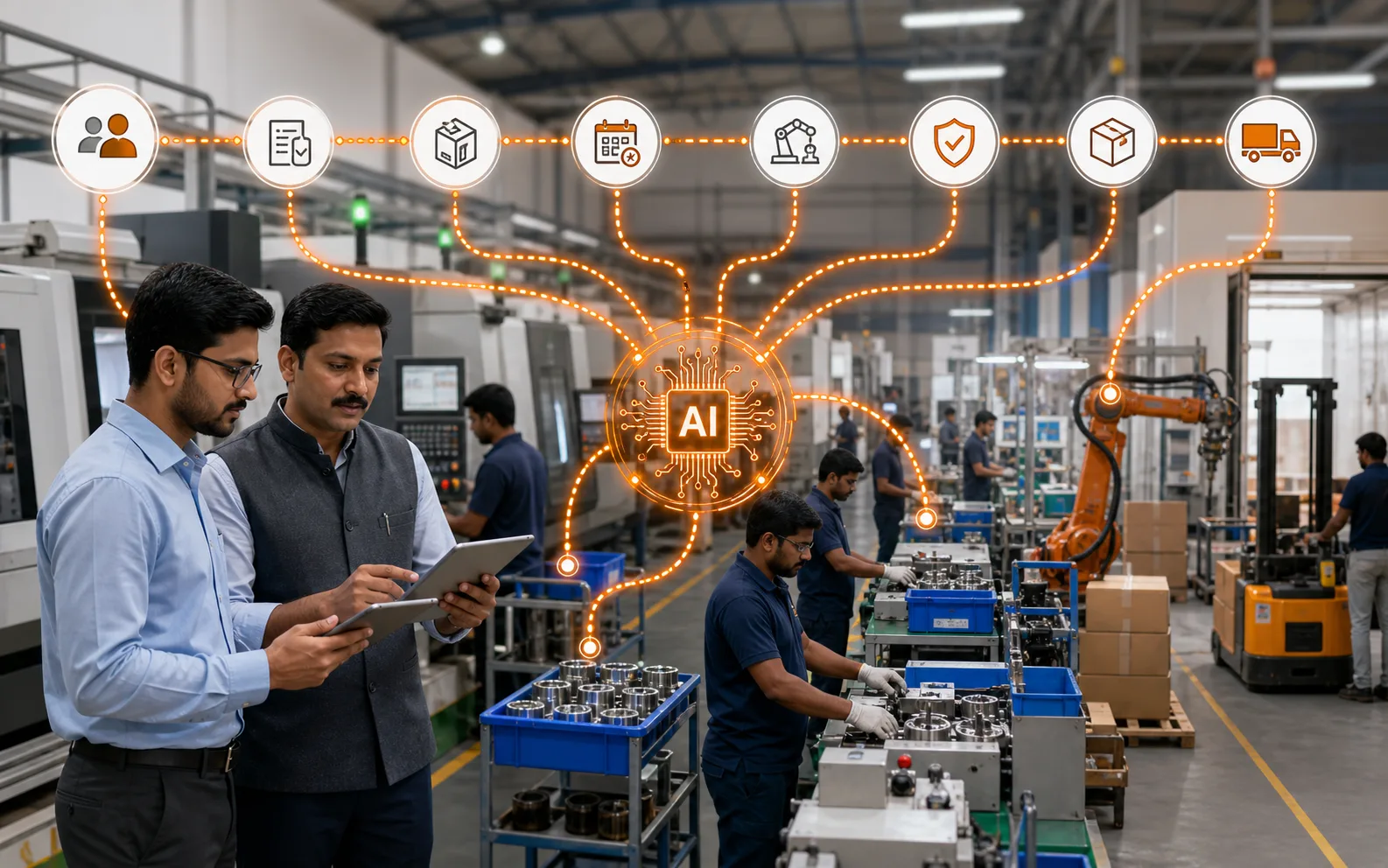
Use Scale when you need the wider team to follow connected factory work without rebuilding the order story in every department and shift. Optiwise is our AI-native OS for manufacturing. Its Manufacturing Intelligence layer connects questions and supported actions with the records behind production, materials, quality and dispatch.
For a large team, the business case should survive a weaker result than your first target. We recommend comparing full, half and quarter time-return cases before treating a headline estimate as a budget.
One order needs one usable picture across shifts
Take an illustrative order for 500 units due for dispatch. Production has recorded 400 units made, but only 360 have passed the required release. Forty are held for a quality decision and 100 have not yet been produced. A sales update saying “400 done” overstates what is ready to ship.
In Optiwise, the next shift follows the production and inspection records rather than using that sentence as a dispatch instruction. The planner sees the remaining work; quality owns the held quantity; sales follows the order’s actual dispatch context. A question about order progress can lead back to the records and the person who must act.
If the 40 held units need rework, keep that work active and record the next inspection outcome. If an output entry is late, reconcile it before making the shipping decision. Our production records and quality workflow keep those distinctions available. Conversational access still follows configured roles and approvals.
Start with half the time you hope to return
The example has 50 main users, including one manager, plus 50 shop-floor users. It uses 26 eight-hour days. The illustrative monthly employment costs are ₹25,000 per office user, ₹18,000 per floor user and ₹40,000 for the manager.
Instead of taking the calculator’s full starting time target, halve each role’s minutes: 15 minutes a day for each of 49 office users, 7.5 minutes for each floor user and 15 minutes for the manager. This gives 318.5 office hours, 162.5 floor hours and 6.5 manager hours each month: 487.5 hours in total.
At those role-specific hourly costs, time value is ₹53,593.75 a month. We set inventory and downtime to zero and add no scrap, maintenance, freight or optional IoT benefit. The result is a time-only case with fewer assumptions to defend.
Separate the licence bill from the time-value target
Scale software is ₹3,60,000 billed yearly, equivalent to ₹30,000 a month. Across the 100 included main and shop-floor users, that is ₹300 per user per equivalent month. The case with half the expected time returned averages about ₹536 in time value per user, leaving ₹23,593.75 of total monthly time value after software.
With monthly billing, software is ₹36,000, or ₹360 per included user. The same half-time-return case leaves ₹17,593.75 after software. The plan details distinguish the billing choices. Implementation costs ₹0; selected add-ons, hardware and applicable taxes are separate. The displayed Scale device package is ₹5,00,000 once and is excluded here.
At unchanged yearly pricing and identical operating months, the same case gives ₹6,43,125 in annual time value against ₹3,60,000 software, leaving ₹2,83,125. The calculator’s five-year view gives ₹32,15,625 time value against ₹18,00,000 software, leaving ₹14,15,625. These are repeated-input scenarios, not predictions of future prices, workloads or cash profit.
What happens if the team returns less time?
| Time-return target achieved | Team hours | Time value | Value after software |
|---|---|---|---|
| Full starting target | 975 | ₹1,07,188 | ₹77,188 |
| Half the starting target | 487.5 | ₹53,594 | ₹23,594 |
| Quarter of the target | 243.75 | ₹26,797 | −₹3,203 |
The yearly equivalent needs roughly 28% of the full target’s time value at these employment costs to cover software. This is not the same as a login or seat-activation percentage. A few managers and many operators have different employment costs and different work. Use the people and minutes that fit your factory.
At a quarter of the assumed time return, this time-only case is below software cost. Investigate why: are records late, do teams still keep parallel updates, or is the expected task change too large? Keep genuinely separate operating savings in their own lines rather than using them to disguise a weak time assumption.
Give the daily handoff a measurable standard
Choose the order or work queue that most often needs reconstruction at shift change. Define what a complete update contains: job reference, actual quantity, accepted or held state, next action and responsible person. Train the people entering it and check whether the next shift can use it without another round of calls.
NIST’s guidance on standard work explains why documented work and feedback provide a basis for measuring improvement. Use that discipline with your own records. It does not establish a particular Optiwise time return.
Observe comparable jobs and shifts before and after the change. Count a person’s task once, even if the same order appears in several dashboards. Keep record corrections and training time visible too. Extra capacity becomes a cash saving only when there is a supported change in spending; otherwise it may let the team handle more work within existing hours.
Test the same case in the calculator
Open the Scale savings calculator. It preselects the plan and its 50 main plus 50 shop-floor users. Set inventory and downtime to zero. Under time assumptions, use 15 office minutes, 7.5 floor minutes and 0.25 manager hours a day. Keep the other losses and optional IoT at zero to reproduce this example.
The manager is already included in the 50 main users. Do not add that person again. Adjust the number of people actually using the system and the time returned, then compare your own monthly, yearly and five-year views.
Does a 100-user allowance guarantee 100 people save time?
No. The allowance defines included access. The estimate needs actual participating users, useful records and a measurable reduction in repeated work. Included seats alone are not an economic benefit.
Is the example’s ₹2,83,125 annual net value a cash saving?
It is employment-cost time value after the yearly software cost. Salaries may stay unchanged. Keep actual cash savings, payment dates, selected extras and taxes in a separate cash-flow assessment.
Book a Scale walkthrough with a real order spanning two shifts and one unresolved production or quality exception. We can show how the teams use the same records and which next action belongs to whom.
Related Posts

What Can a Five-User Factory Save With Optiwise Digitize?
See a five-user Digitize example: 65 hours of team time worth ₹8,750 monthly, software costs, break-even minutes and a practical order-to-material workflow.
2 Nov 2026Read more →
Wait for Cheaper Software or Start a Focused Factory Rollout?
Compare a defined first workflow with the recorded cost of waiting. Optiwise implementation costs ₹0; recurring software, add-ons and devices remain separate.
9 Jun 2026Read more →MSME networking events and trade fairs 2024: International opportunities for Indian businesses
Written by Reading progress Call us As we step into 2024, the landscape for Micro, Small, and Medium Enterprises (MSMEs) is evolving rapidly. With digital transformation becoming the norm, it’s crucial for Indian busines…
17 Apr 2026Read more →
Circular Design Principles for MSME Products: From Concept to Consumer
Written by Reading progress Call us As we step into 2024, the landscape for Micro, Small, and Medium Enterprises (MSMEs) is evolving rapidly. With digital transformation becoming the norm, it’s crucial for Indian busin I…
28 Oct 2025Read more →