
Best ERP for Auto-Component Manufacturers in India: 12 Demo Checks
Best ERP for Auto-Component Manufacturers in India: 12 Demo Checks. Use a worked factory scenario, explicit inputs and exception checks before rollout.
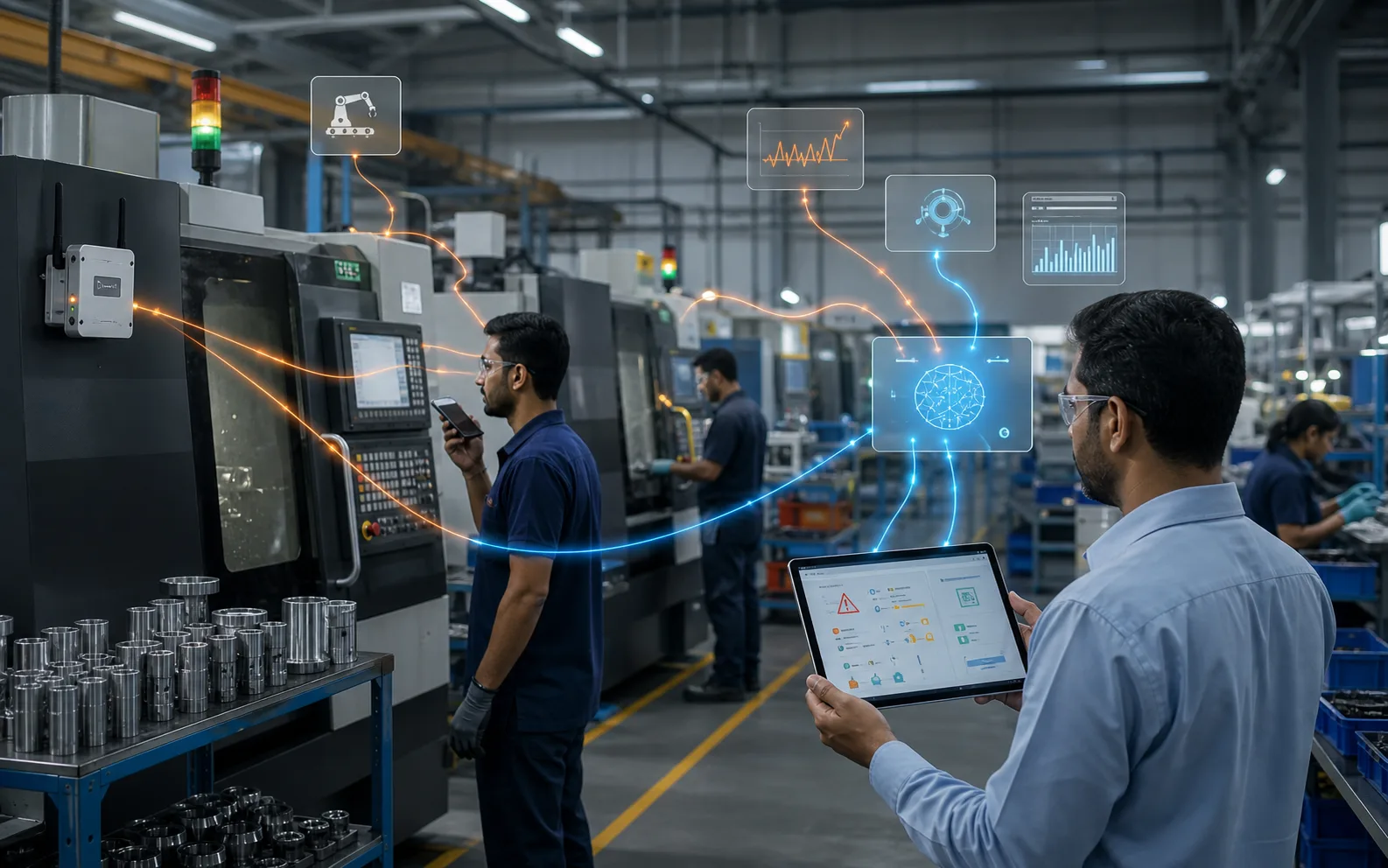
Best ERP for Auto-Component Manufacturers in India: 12 Demo Checks gives you a practical way to select ERP for Indian auto-component operations with evidence. Use a representative order, the real roles who perform the work and at least one difficult exception.
A supplier delivers a lot late, production completes a partial quantity, quality rejects two pieces and the customer changes the dispatch date. The ERP must show who acts next and keep the complete trail.
Make the decision before choosing the screen
Judge vendors on traceable revisions, material and outside work, production, inspection, corrections and Indian operating roles.
We connect sales, purchasing, inventory, production, quality, subcontracting and dispatch records in role-specific workflows.
ISA-95 is the external process or control reference for this guide. It does not prove an Optiwise feature or a business result; our product statements come from our current product record.
| Step | Required input | Evidence to capture |
|---|---|---|
| 1 | Part, customer and revision controls | Named owner and definition |
| 2 | Material, supplier and subcontract flow | Current source record |
| 3 | Machine, worker and quantity entries | Acceptance rule |
| 4 | Quality, dispatch and audit evidence | Correction and escalation |
Run the workflow with accountable roles
- 1. Part, customer and revision controls. Name the role that owns this record and decision.
- 2. Material, supplier and subcontract flow. Use a current value from the representative order.
- 3. Machine, worker and quantity entries. Write the passing condition before the test.
- 4. Quality, dispatch and audit evidence. Assign correction and escalation responsibility.
Reconcile the result by hand. When the system differs from the source record, classify the gap as master data, timing, transaction ownership, permissions or configuration before changing the process.
Test the exceptions that disrupt a normal day
- Lot certificate is corrected: record the expected status, permitted action, approver, correction path and audit evidence.
- Operation moves outside: record the expected status, permitted action, approver, correction path and audit evidence.
- Customer date changes after release: record the expected status, permitted action, approver, correction path and audit evidence.
A quick normal transaction is useful. A controlled exception shows whether the workflow can survive real factory conditions.
Connect this task to the operating workflow
review the first product workflow, check the connected module, prepare the supporting records, see the control step, read the related guide. Book a connected Optiwise demo and ask us to run your scenario with the normal path, exception and correction.
Questions to settle during the demo
What should we prepare?
Prepare one representative order, the four inputs above and one complication your team encounters today. You can remove confidential values while keeping the record relationships intact.
What is a passing result?
Accept the workflow when the normal path and exceptions leave a complete, role-appropriate record another person can reconcile. Validate the configured capability separately from any promised commercial or operational outcome.
The best ERP for auto component manufacturers in India is the one that understands both manufacturing complexity and local operating reality.
Indian auto component companies often work with demanding OEMs, tier-one suppliers, tight dispatch schedules, fluctuating material prices, job work, subcontracting, GST documentation, quality audits, and constant pressure on working capital. Many factories still run important decisions through Excel, WhatsApp, phone calls, and manual registers because their existing software does not match the way production actually works.
That creates a familiar problem. The company has software, but managers still ask people for status manually. Stock exists in the system, but stores must physically verify it. Production plans exist, but material shortages appear late. Quality records exist, but audit preparation still feels stressful.
A good ERP should reduce this gap between system data and shopfloor truth.
For Indian manufacturers, AICAN Optiwise is relevant because it is designed around practical factory visibility: production, inventory, purchase, quality, and reporting working together rather than as separate islands.
What Makes Auto Component Manufacturing in India Different?
Auto component manufacturing in India has its own rhythm. Some companies supply large OEMs. Some supply tier-one or tier-two customers. Some handle machining, fabrication, moulding, casting, forging, assembly, plastic components, rubber parts, electrical assemblies, or precision parts. Many combine in-house operations with subcontracted processes.
The ERP must handle this variety without becoming too heavy for daily use.
Common realities include:
- Customer schedules that change frequently.
- Part-wise and customer-wise delivery commitments.
- Multi-level BOMs and process routes.
- Raw material price variation.
- Job work and subcontractor movement.
- Incoming, in-process, and final inspection.
- Rework, scrap, and rejection tracking.
- GST invoices, e-way bills, and dispatch documentation.
- OEM audit and traceability expectations.
- Pressure to reduce inventory while avoiding shortages.
An ERP that ignores these realities will either require too much customization or push teams back into manual work.
The Best ERP Should Support Indian Factory Workflows
Many ERP evaluations begin with accounting and billing. Those are important, but auto component manufacturers should begin with operations.
The system should support the flow from customer demand to dispatch:
- Customer order or schedule is received.
- Material requirement is calculated from BOM.
- Purchase and supplier follow-up are triggered.
- Raw material is received and inspected.
- Production is planned based on availability and priority.
- Material is issued to shopfloor.
- Operations are completed and reported.
- Quality checks are recorded.
- Finished goods are packed and dispatched.
- Management reviews cost, delivery, and quality performance.
If the ERP only handles a few of these steps, the remaining gaps become Excel files. Over time, those files become the real operating system of the company.
The best ERP should make the official system useful enough that teams do not need parallel records for basic control.
Production Planning Must Be Practical, Not Decorative
Auto component manufacturers need production planning that works with material availability, machine capacity, customer priority, and dispatch dates. A plan that looks good in a meeting but ignores shortages is not useful.
The ERP should help answer:
- Which parts must be produced today and this week?
- Which customer schedules are at risk?
- Which raw materials or child components are short?
- Which purchase orders are delayed?
- Which jobs are waiting for subcontractor return?
- Which finished goods are ready but not dispatched?
Planning should not depend only on one senior person’s memory. A good ERP should help institutionalise the planning logic so the business is less fragile.
AICAN Optiwise supports this kind of manufacturing visibility by connecting production planning with inventory, purchase, and operational status.
Inventory Control Is a Working Capital Issue
In India, many auto component manufacturers carry extra stock because they do not fully trust system data. This protects production in the short term but increases working capital pressure.
On the other side, if stock records are inaccurate, the factory may discover shortages only when production is about to start. Then purchase teams chase suppliers urgently, production reschedules work, and delivery commitments become risky.
A suitable ERP should track:
- Raw material stock.
- Bought-out components.
- WIP.
- Finished goods.
- Rejected and hold stock.
- Material issued to production.
- Material sent to subcontractors.
- Material pending inspection.
- Customer-specific stock where required.
The system should also make stock movement easy to record. If transactions are too slow or confusing, teams will postpone entry and the reports will lose trust.
Job Work and Subcontracting Cannot Be an Afterthought
Many Indian auto component companies send material outside for heat treatment, coating, plating, machining, testing, or specialized processing. If the ERP does not handle this cleanly, subcontractor stock becomes a blind spot.
The system should show:
- Material sent out.
- Material received back.
- Pending quantities at each vendor.
- Process-wise subcontracting cost.
- Rejections at vendor or after receipt.
- Expected return dates.
- Documents linked to job work movement.
This matters because job work delays can break production plans. A factory may have raw material and machine capacity but still miss dispatch because a subcontracted process is late.
The best ERP for India should treat subcontracting as a normal manufacturing flow, not an exception handled manually.
Quality and Audit Readiness Matter
Auto component customers often expect quality discipline. Even smaller suppliers may face audits, inspection documentation, corrective actions, and traceability requirements.
A good ERP should support quality checks across stages:
- Incoming inspection.
- In-process inspection.
- Final inspection.
- Dispatch inspection.
- Rejection and rework recording.
- Customer complaint tracking.
- Supplier rejection analysis.
- Corrective action follow-up.
The value is not only documentation. It is faster investigation. When a customer reports an issue, the company should be able to trace the batch, material, production process, inspection result, and dispatch details without searching through paper files.
This is where connected systems matter. Quality should not be separate from production and inventory. It should be part of the same operational record.
GST, Dispatch, and Compliance Fit
Indian manufacturers also need ERP workflows that support local documentation. GST invoices, e-way bills, customer dispatch requirements, and tax-aligned records must be handled reliably.
While tax compliance is not the only reason to choose an ERP, poor documentation flow creates daily friction. Dispatch teams need accurate customer details, item details, HSN/SAC where applicable, tax values, packing information, and shipment status.
The best ERP should reduce duplicate entry and help ensure that commercial records match operational movement.
What Indian Auto Component Manufacturers Should Avoid
A few ERP selection mistakes are common.
First, do not choose an ERP only because it is famous. A large brand may still be too generic, expensive, or heavy for the company’s current stage.
Second, do not choose only the cheapest option. If the system cannot handle production, inventory, quality, and traceability properly, the hidden cost will appear as manual work.
Third, do not over-customize everything on day one. Excessive customization can slow implementation and make upgrades difficult. Focus first on the workflows that create daily control.
Fourth, do not ignore user adoption. If stores, production, purchase, and quality teams find the system difficult, data accuracy will suffer.
A Practical ERP Evaluation Checklist
Before choosing an ERP, Indian auto component manufacturers should ask:
- Can it handle our BOM and routing structure?
- Can it plan production from customer schedules and inventory?
- Can it track raw material, WIP, finished goods, rejected stock, and subcontractor stock?
- Can it manage purchase follow-up and supplier delays?
- Can it record quality checks at required stages?
- Can it support traceability for customer complaints and audits?
- Can it handle job work and outside processing?
- Can it support GST-ready commercial flow?
- Can shopfloor users actually use it every day?
- Can management see live operational risk?
If the answer is weak in these areas, the ERP may not be suitable for auto component manufacturing.
Why AICAN Optiwise Is a Strong Fit
AICAN Optiwise is designed for manufacturing companies that need practical visibility and control. For Indian auto component manufacturers, this means bringing production, purchase, inventory, quality, dispatch, and management reporting into one connected operating flow.
The real benefit is not only digitisation. It is fewer blind spots. Teams can see what is pending, what is short, what is delayed, what is rejected, and what needs attention.
You can also learn more about the company behind the product at About AICAN.
Founder’s Note
Indian manufacturers are extremely resourceful. Many factories run complex operations with lean teams and high pressure. But resourcefulness should not mean living with avoidable confusion every day.
A good ERP should make the factory calmer. Not slower, not more bureaucratic, but clearer. When teams trust the data, they spend less time chasing status and more time improving the business. That is the direction we care about at AICAN.
FAQs
Which ERP is best for auto component manufacturers in India?
The best ERP is one that supports Indian manufacturing workflows such as production planning, BOM, inventory, purchase, quality, traceability, job work, dispatch, and GST-ready operations. AICAN Optiwise is built for connected factory visibility.
Why do auto component companies need ERP?
They need ERP to manage production schedules, material availability, supplier follow-up, quality records, dispatch commitments, costing, and traceability without depending on scattered manual records.
Is job work management important in ERP?
Yes. Many Indian auto component manufacturers rely on outside processes. ERP should track material sent out, received back, pending at vendor, subcontracting cost, and related quality issues.
Should ERP include quality management?
Yes. Quality management helps with inspection records, rejection tracking, customer complaints, supplier issues, and audit readiness. In automotive supply chains, quality data must be connected to production and traceability.
How can AICAN Optiwise help Indian manufacturers?
AICAN Optiwise helps manufacturers connect production, inventory, purchase, quality, and reporting so teams can work from clearer, more current information.

Related Posts

Kanban System | Optiwise
Learn how a Kanban system works in manufacturing, where it helps, where it fails, and how Optiwise connects Kanban signals with inventory, purchase, and production planning.
12 Jun 2026Read more →Erp In Operations Management | Optiwise
Learn how ERP improves operations management by connecting planning, inventory, purchase, production, quality, dispatch, finance, and reporting.
12 Jun 2026Read more →ERP for FMCG Companies in India
A practical guide to ERP for FMCG companies in India, covering distributor orders, batch tracking, expiry, inventory, production, schemes, costing, and reporting.
11 Jun 2026Read more →
Optiwise, Odoo, Acumatica and Business Central for Manufacturing
Compare manufacturing workflows in Optiwise, Odoo, Acumatica and Dynamics 365 Business Central. See what your factory can run in Optiwise.
11 Jun 2026Read more →