
Coolant Concentration Log: Record the Reading and the Correction
Log coolant readings, supplier correction factors, authorised actions and rechecks. Includes an illustrative concentration calculation and review checks.

A coolant concentration record should retain fluid identity, the raw refractometer reading, the product-specific correction factor, the calculated concentration and any authorised action. Keep the original result and a separate recheck so a correction can be reviewed.
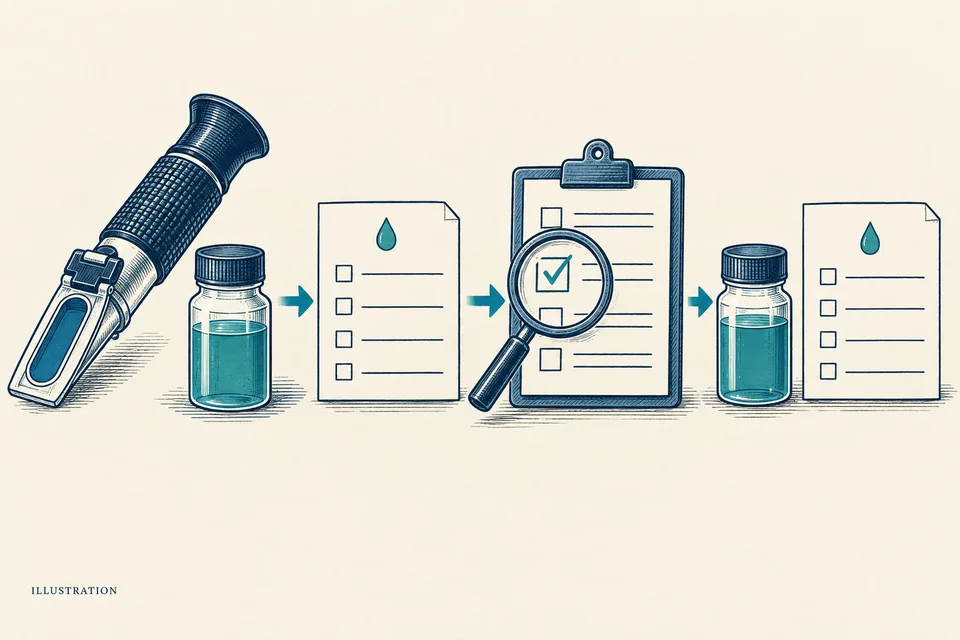
The machine log says “coolant checked, topped up.” The next shift cannot tell which product was in the sump, what was measured or whether the correction was checked. A useful log keeps the measurement and the action separate.
Record the product before interpreting the reading
The HSE guidance on managing metalworking-fluid quality calls for concentration monitoring against the fluid supplier’s recommendations. Its example record calculates concentration from the refractometer reading and the fluid’s correction factor. Use the current instructions for the actual product and instrument; the factor is not interchangeable across fluids.
The fluid-control owner sets the sampling method, required checks and action limits with the supplier. The operator records the observation using that procedure. This worksheet organises the evidence; it does not choose a concentration range or top-up recipe.
| Field | Evidence to retain |
|---|---|
| Machine and fluid system | Asset ID, sump or system ID, product name and batch if known |
| Method reference | Supplier instruction revision, instrument ID and required instrument checks |
| Original test | Time, sample point, raw reading, units and observer |
| Conversion | Product-specific factor, calculated concentration and approved range |
| Decision | Within range, repeat test, hold or supplier review; named authority |
| Correction and recheck | Approved instruction, actual action, time and separate result |
Check the arithmetic without borrowing the example as a limit
Illustrative scenario: a fictional supplier sheet specifies a factor of 1.5 for one fluid and the raw reading is 4.0. The calculated concentration is 4.0 × 1.5 = 6.0%. The example demonstrates multiplication only. It does not establish whether 6.0% is suitable for your fluid, material or operation.
If a later recheck gives 4.4 with the same verified factor, its calculated concentration is 6.6%. Retain both results with their times and the action between them. Do not replace the first reading with 4.4 or record the raw reading as the concentration percentage.
Keep corrections under an approved instruction
When the reading is outside the approved range, record the exception and notify the fluid-control owner. That owner checks product identity, instrument method, sample condition and supplier guidance before authorising an action. Capture the instruction reference and actual quantities used where the approved procedure requires them.
The recheck occurs at the stage defined by that procedure. Record its result even if the action did not achieve the expected condition. Assign the unresolved exception to the owner; a tick beside “top-up completed” does not close it.
Unknown product identity, a missing correction factor or an unclear reading blocks interpretation. Escalate rather than borrowing a value from a nearby machine. An unusual appearance or odour also needs the applicable fluid-quality response. Concentration alone does not establish microbial condition, pH or overall suitability.
Review the log before closing the shift
The supervisor checks that each required observation has a product, time, method and original reading; every conversion uses the documented factor; and each corrective action has a separate recheck or an open exception. The acceptance check is a complete, traceable record, plus the actual technical acceptance required by the fluid owner.
Over several comparable periods, review repeat exceptions by machine and product. Keep changes in fluid, water source, work material and production pattern beside the trend. A lower number of exceptions is meaningful only if the required checks were completed.
Capture the record in Optiwise
Our no-code forms support conditional fields, required completion and attachments. Configure the raw reading, factor source, calculation and recheck as separate fields, with the supplier instruction attached. Link the record to the relevant production process when an exception affects work.
Coolant-record questions
Is the refractometer reading always the concentration percentage?
No. Use the actual product’s specified conversion and instrument instructions. Keep the raw reading and calculated concentration as separate fields.
Can a corrected concentration close every fluid-quality concern?
No. Other required checks and unresolved observations remain open. The fluid-control owner must assess them under the applicable supplier and site procedure.
Bring your current fluid-check form to an Optiwise demo to map its readings, exceptions and rechecks.
Related Posts

Fabric Shade Groups: Allocate Rolls to a Cutting Lay
Allocate fabric rolls to cutting lays with shade-group approval, usable-length checks and remnant identity. Includes a two-group worked allocation example.
30 Sept 2026Read more →
Powder Coating Reclaim: Keep Each Blend Traceable
Build a powder-coating reclaim record with parent lots, approved blend rules, mass reconciliation and job links. Includes a clearly illustrative balance example.
30 Sept 2026Read more →
Torque Tool Job Changes: Record the Approved Setting
Use a torque-tool job-change record to connect joint revision, units, tool identity, setup verification and the first affected assembly without inventing settings.
30 Sept 2026Read more →Opened Adhesive Containers: Record Dates Before Reissue
Track partially used adhesive containers with opening dates, supplier limits, storage exceptions and an issue-return worksheet. Avoid invented expiry extensions.
30 Sept 2026Read more →