
Corrected Supplier Certificates: Review Every Affected Lot
Preserve the original certificate, identify the correction and trace affected receipts, WIP and shipments before closing the review record.

When a supplier corrects a certificate, retain the original, identify exactly what changed and trace every receipt and downstream lot that relied on it. Quality must record whether the correction changes acceptance or requires further action before the review can close.
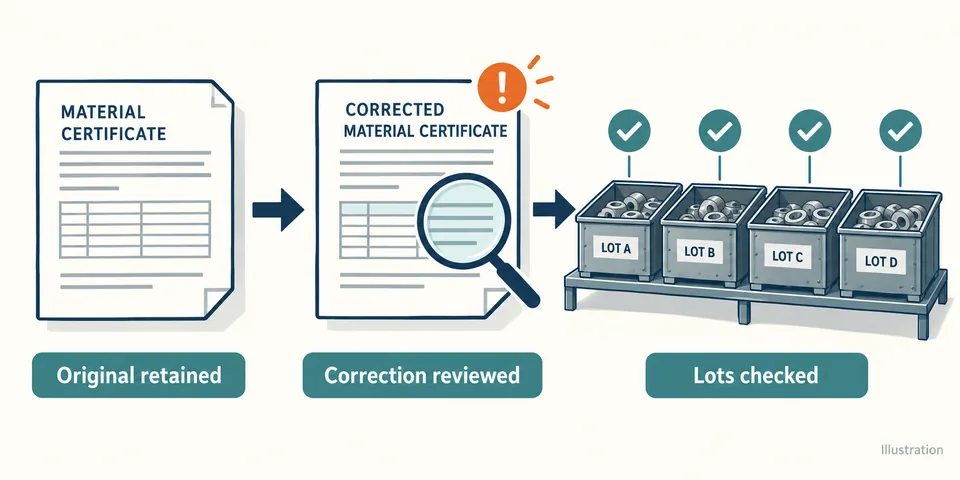
A revised material certificate arrives after some of the lot has entered production. Replacing the attachment on the latest receipt would hide the evidence used for earlier decisions. The quality lead needs a correction record that links both documents to the affected material and the decision made for each location.
Establish the identity and reason for the correction
Capture the issuer, original report number and date, replacement or supplement identifier, received date, affected material identity and the supplier’s explanation. Verify the correction through the normal supplier contact route if its origin or scope is unclear. Preserve the files as received and retain the correspondence that explains their relationship.
NATA’s reporting guidance explains that amendments and replacement reports should be identifiable and linked to the original. Its requirements apply in its accreditation context. The receiving workflow below uses that document-linking principle without assuming that every supplier certificate is an accredited laboratory report.
Compare changed fields before releasing anything
Separate administrative corrections from changes to material identity, test results, units, specification, method or conformity statement. A corrected address may have a different consequence from a changed heat number. The responsible quality reviewer decides the impact; the document’s newer date alone does not establish that existing stock remains acceptable.
| Location or state | Quantity | Required decision record |
|---|---|---|
| Unused receipt lot L21 | 40 pieces | Hold/release decision against corrected evidence |
| Open job WO-811 | 35 pieces | Identify affected WIP and next permitted step |
| Finished stock FG-18 | 15 pieces | Review acceptance and dispatch status |
| Already dispatched | 10 pieces | Trace shipment and determine required communication |
| Total received population | 100 pieces | 40 + 35 + 15 + 10 = 100 |
These quantities are illustrative. If one material lot feeds several finished lots, preserve the relationship rather than assuming the receipt number is sufficient. If the original population cannot be reconciled, record the gap and keep the relevant review open. Avoid counting a WIP unit again after it moves to finished stock.
Record the impact without rewriting history
For each affected record, retain the original acceptance date, evidence used at that time, current review decision, reviewer and supporting reason. A later correction must not make it appear that the corrected document existed at the original release. If additional testing, containment or customer communication is needed, assign it through the applicable quality process.
If the correction changes only formatting, retain that conclusion with the comparison that supports it. If the issuer cannot explain a changed result or identity, escalate the uncertainty. Do not edit the supplier’s certificate yourself to make it match your records, and do not infer a satisfactory result from a missing value.
Close the document and stock reviews together
The purchasing owner obtains missing issuer information. Stores confirms physical locations and holds. Production traces consumption and WIP. Quality approves the impact decision and confirms required downstream actions. The review closes when the original and new documents remain retrievable, the affected population reconciles and every required action has completion evidence.
A useful pilot is one corrected certificate with material in more than one state. Have a second reviewer trace from the correction to a receipt and then to the affected output. Record any broken link as an open action. This checks the record chain without pretending that an attachment alone proves compliance.
Link the correction in Optiwise
Our lot references and item transaction drilldown help trace stock movements. Attachment-supported forms and custom fields let you configure the correction review and retain both documents. Keep the quality decision explicit; storing a file does not automatically requalify material.
Certificate questions
Can we delete the superseded certificate?
Retain it under your document-retention rules with a clear superseded status and a link to the correction. It explains the evidence available for earlier decisions.
Does every correction require rejecting the lot?
No. Quality evaluates the changed information and applicable requirements. Record the justified decision and any required hold, testing or downstream action.
Related Posts

Fabric Shade Groups: Allocate Rolls to a Cutting Lay
Allocate fabric rolls to cutting lays with shade-group approval, usable-length checks and remnant identity. Includes a two-group worked allocation example.
30 Sept 2026Read more →Powder Coating Reclaim: Keep Each Blend Traceable
Build a powder-coating reclaim record with parent lots, approved blend rules, mass reconciliation and job links. Includes a clearly illustrative balance example.
30 Sept 2026Read more →
Torque Tool Job Changes: Record the Approved Setting
Use a torque-tool job-change record to connect joint revision, units, tool identity, setup verification and the first affected assembly without inventing settings.
30 Sept 2026Read more →
Opened Adhesive Containers: Record Dates Before Reissue
Track partially used adhesive containers with opening dates, supplier limits, storage exceptions and an issue-return worksheet. Avoid invented expiry extensions.
30 Sept 2026Read more →