
Hydraulic Filter Replacement: Match the Element Before Issue
Check hydraulic filter identity and specifications before issue. Use a worksheet for receiving holds, service readings and maintenance handback.

Before issuing a replacement hydraulic filter, match the machine position, approved part identity, pressure and filtration requirements, and design configuration. Keep the evidence with the issue record, then retain the installation and service-reading handback separately.
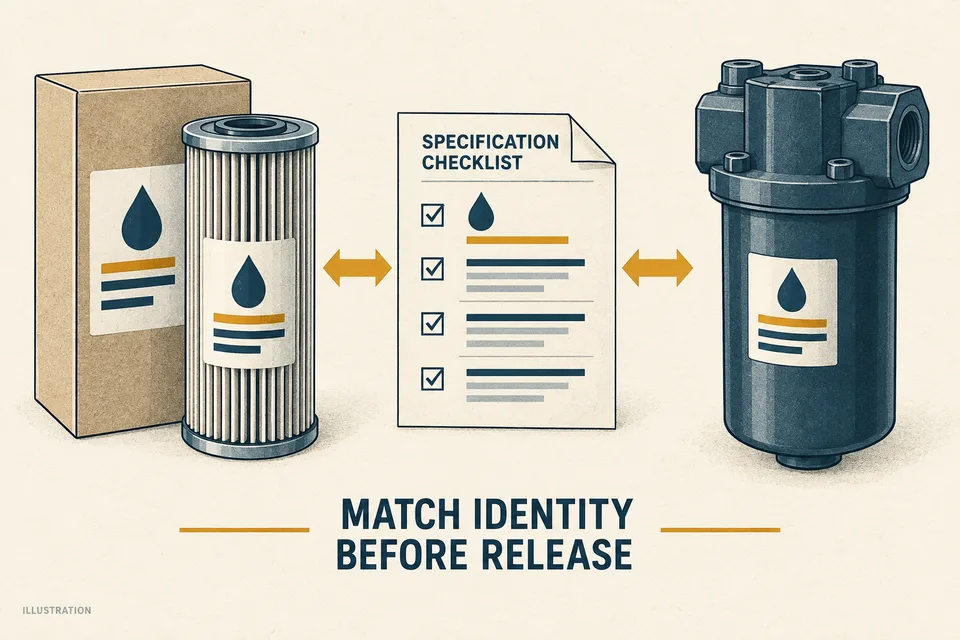
Stores has a filter element that looks like the one maintenance removed. Its dimensions match the space in the housing. The maintenance owner still needs the specification evidence before accepting it for that position.
Start with the machine position and approved requirement
Donaldson’s hydraulic-filter replacement guidance explains that pressure, filtration efficiency and design structure matter when replacing a filter. A matching external shape is insufficient. The equipment manufacturer’s requirements determine the permitted replacement and maintenance schedule.
Open the record when maintenance requests an element for a named asset and filter position. Include the machine model, housing reference, installed part identity where known, approved replacement number and source document revision. A factory with several similar housings needs a position identifier, not just “hydraulic filter.”
Use a comparison sheet before issue
| Check | Required evidence | Decision owner |
|---|---|---|
| Asset and circuit position | Machine and housing reference match the request | Maintenance |
| Part identity | Approved number versus actual package and element markings | Stores records; maintenance accepts |
| Pressure and filtration requirement | Manufacturer specification for this position | Qualified maintenance reviewer |
| Design configuration | Housing, element and bypass arrangement match the approved design | Qualified maintenance reviewer |
| Condition and documentation | Packaging condition, supplier document and traceable stock identity | Stores and receiving |
| Service basis | Manufacturer interval or approved condition-based instruction | Maintenance planner |
Mark each line matched, mismatched or unresolved. “Not applicable” needs a reason. An item catalogue description that omits a critical rating leaves that line unresolved; it is not a pass.
Resolve a plausible-looking substitute
Illustrative scenario: the approved request names element F-A. A supplier delivers F-B and provides a dimensional drawing. The package is intact and the dimensions match, but the supplied documents do not establish the required efficiency and bypass configuration.
Stores records receipt to the controlled location and attaches the package photograph. Maintenance keeps installation release on hold. Purchasing obtains the manufacturer’s relevant specification or an authorised engineering decision. The record links the response to the exact delivered element before issue.
If the alternative is approved, retain the scope: which asset and position it covers, which document supports it and whether the approval is temporary. Use the material-substitution workflow for that decision. A replacement delivered against the original request does not itself change the approved requirement.
Separate issue, installation and return to service
The stock issue shows who received the element and for which job. Installation is performed under the machine’s authorised maintenance procedure, including its isolation requirements. This record does not replace that procedure.
At handback, retain the removed and installed identities, job reference, completion time, required inspection or test evidence and the authorised return-to-service decision. If an operating-hours reading controls service, record the actual reading and its unit. Keep the cumulative machine reading even when a separate service counter resets.
A changed meter needs a linked old and new reading. A partial job remains open with the machine state and next owner stated. An element issued but unused must be returned or otherwise reconciled; it should not remain recorded as installed.
Close the record through reconciliation
Accept closure when the installed identity matches the approved decision, stock issue and unused returns reconcile, the service reading has a source, and the maintenance handback includes all required evidence. Review mismatches by supplier and part number so purchasing can correct repeated catalogue ambiguity.
In Optiwise inventory, item transaction history connects stock movements. Our no-code forms add mandatory fields, attachments and role-based access for the identity check and handback. Configure the record around your maintenance procedure and authorised reviewer.
Filter-replacement questions
Can physical fit prove a hydraulic filter is equivalent?
No. Match the approved pressure, filtration and design requirements for the actual position. Resolve missing evidence with the responsible technical reviewer before installation release.
Should a service-counter reset erase the machine-hours reading?
No. Preserve the actual cumulative reading and record the service reset separately. That retains the interval history for the next review.
Bring one filter request and handback record to an Optiwise demo to connect the specification, issue and service evidence.
Related Posts

Fabric Shade Groups: Allocate Rolls to a Cutting Lay
Allocate fabric rolls to cutting lays with shade-group approval, usable-length checks and remnant identity. Includes a two-group worked allocation example.
30 Sept 2026Read more →
Powder Coating Reclaim: Keep Each Blend Traceable
Build a powder-coating reclaim record with parent lots, approved blend rules, mass reconciliation and job links. Includes a clearly illustrative balance example.
30 Sept 2026Read more →
Torque Tool Job Changes: Record the Approved Setting
Use a torque-tool job-change record to connect joint revision, units, tool identity, setup verification and the first affected assembly without inventing settings.
30 Sept 2026Read more →
Opened Adhesive Containers: Record Dates Before Reissue
Track partially used adhesive containers with opening dates, supplier limits, storage exceptions and an issue-return worksheet. Avoid invented expiry extensions.
30 Sept 2026Read more →