
Machine Spare Transfers: Track Donor and Receiver Status
Approve both sides of a machine spare transfer, preserve component identity and assign donor restoration with a practical custody register.

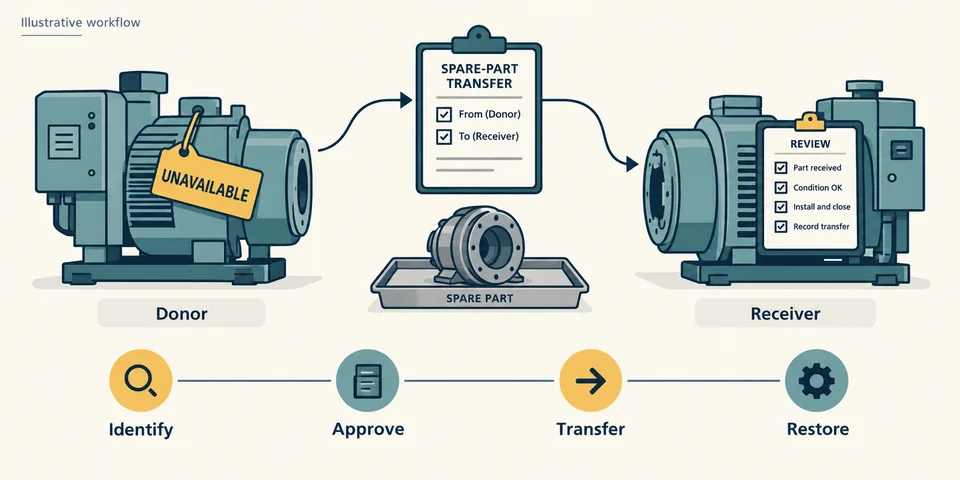
A spare-part transfer between machines needs approval for both the receiving machine and the machine losing the part. Record compatibility evidence, each machine's resulting state and a named plan to restore the donor before removing the component.
This decision sheet is for a maintenance lead, production planner and stores owner facing an urgent shortage. It organises the approval and custody record. Competent maintenance personnel must determine technical suitability and carry out work under the machine manufacturer's instructions and the site's safe-maintenance procedures.
Identify both machines and the actual component
Collect asset IDs, component identification, revision or specification, service history where relevant, known condition and the manufacturer's compatibility information. A visually similar part is insufficient evidence. Record why the donor is available and when its next committed job requires it.
HSE's work-equipment maintenance guidance emphasises competent people, appropriate instructions and safe isolation. The transfer record refers to those controls; it does not authorise bypassing them or prescribe a repair method.
| Decision | Evidence | Owner |
|---|---|---|
| Technical suitability | Identified component, approved specification and condition review | Competent technical authority |
| Donor availability | Lost function, affected jobs and next required date | Production planner |
| Work authorisation | Maintenance instruction, isolation reference and assigned personnel | Maintenance lead |
| Custody | Removal, transfer and installation records with timestamps | Maintenance and stores |
| Restoration | Replacement source, due date, owner and donor release checks | Maintenance lead with purchasing |
Compare the disruption on both sides
Illustrative scenario: Machine A is stopped and Machine B has no planned work until Thursday morning. A technically approved transfer could return A to service after the required checks. The replacement intended for B is expected Wednesday afternoon.
The planner must check the reliability of that arrival, the installation and release window, and alternatives if the replacement is late. If B needs four hours of authorised restoration and verification, an arrival shortly before Thursday's shift leaves little margin. Moving the part may move the delivery risk to B's next job.
Record the decision against the actual affected orders. Avoid a single “hours saved” figure that counts A's recovery but ignores B's lost availability. Keep estimated timings labelled as estimates until maintenance records the actual events.
Track machine state after the transfer
Once the part leaves B, update B's availability and identify its restriction at the point of use. A free slot in the calendar must not suggest the machine is ready. The transfer stays open until the donor has been restored and released, or an authorised decision changes its future use.
For the receiving machine, retain the installation reference and required verification. If compatibility or condition is uncertain, pause the transfer and obtain the technical decision. Safety-related components need their applicable specialist controls; production urgency is not a substitute for them.
At closure, reconcile one removal with one destination. Record what happened to the failed component and whether any loaned or replaced item has returned. If an item is scrapped, repaired or sent to a supplier, link that disposition instead of leaving its location as “maintenance.”
Link the register to Optiwise records
Our inventory and asset issue/return workflows support recorded custody changes. You can configure a linked no-code transfer register for donor, receiver, technical approval and restoration ownership. Machine planning records should reflect the donor's unavailable period.
For a pilot, require both asset identities on every transfer, zero unapproved substitutions and a restoration owner and date for every donor. Review overdue donor restoration separately from receiver recovery. A recovered production line does not close the second obligation.
Spare transfer questions
Can a stock-transfer entry authorise the installation?
No. It records movement. Technical suitability, maintenance authorisation and release checks require their own competent owners and evidence.
What if the donor will never return to production?
Record the authorised decommissioning or change-of-use decision and update the asset plan. Do not leave an indefinite restoration task with no decision owner.
Bring one recent transfer and its donor-restoration record to an Optiwise workflow demo.
Related Posts

Fabric Shade Groups: Allocate Rolls to a Cutting Lay
Allocate fabric rolls to cutting lays with shade-group approval, usable-length checks and remnant identity. Includes a two-group worked allocation example.
30 Sept 2026Read more →
Powder Coating Reclaim: Keep Each Blend Traceable
Build a powder-coating reclaim record with parent lots, approved blend rules, mass reconciliation and job links. Includes a clearly illustrative balance example.
30 Sept 2026Read more →Torque Tool Job Changes: Record the Approved Setting
Use a torque-tool job-change record to connect joint revision, units, tool identity, setup verification and the first affected assembly without inventing settings.
30 Sept 2026Read more →
Opened Adhesive Containers: Record Dates Before Reissue
Track partially used adhesive containers with opening dates, supplier limits, storage exceptions and an issue-return worksheet. Avoid invented expiry extensions.
30 Sept 2026Read more →