
Returnable Crates: Reconcile the Customer Balance
Reconcile reusable transport crates by owner, type and customer, separating physical returns, damage and disputed balances from product quantities.

Reconcile returnable crates by owner, container type and customer using opening balance plus dispatches minus acknowledged returns and authorised transfers. Count physical returns separately from serviceable packaging, and keep disputed or damaged quantities visible until resolved.
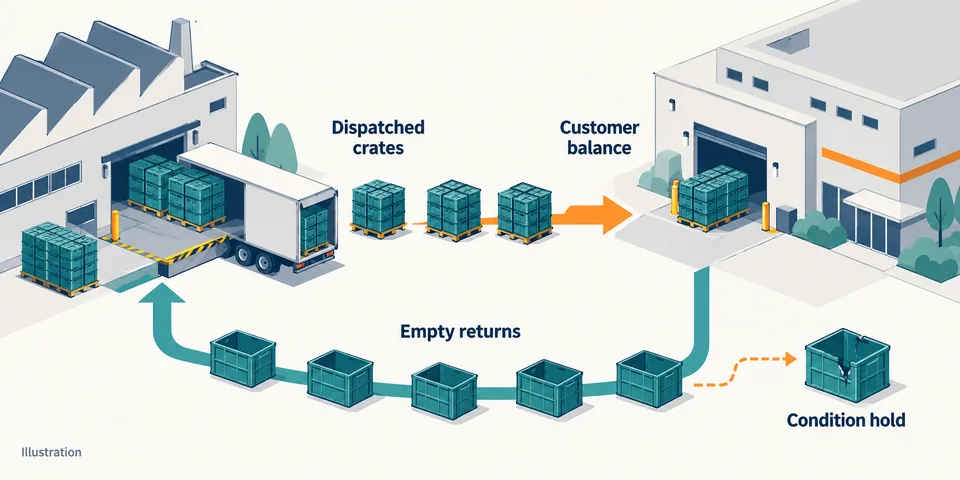
Finished goods have been delivered, but the empty crates have not returned. The dispatch team needs the goods record; the packaging coordinator needs a continuing container balance across several deliveries. Counting cartons of product cannot answer how many reusable crates each customer still holds.
Define the unit and ownership of the pool
Identify the container owner, type, quantity unit and any individual identifiers. Keep customer-owned crates separate from your own pool even when their dimensions match. Define whether a “set” includes a lid or insert; a return of 20 bases with 17 lids is not automatically 20 complete sets.
GS1 explains that GRAI identifies reusable transport assets such as crates, trays and pallets. You can use an appropriate identification method for the agreed pool. This guide does not assume RFID is required or that your current labels already implement a GS1 key.
Reconcile the customer account at a cutoff
| Movement or state | Quantity | Meaning |
|---|---|---|
| Opening crates held by customer | 80 | Previously agreed closing balance |
| Crates dispatched this week | 120 | Acknowledged outward movements |
| Crates physically returned | 95 | Counted inward receipts |
| Closing crates at customer | 80 + 120 − 95 = 105 | Expected custody balance |
| Of the 95 returns, serviceable | 87 | Available after the required check |
| Of the 95 returns, condition hold | 8 | Physically returned; not yet usable |
The eight damaged or uncertain crates reduce the usable pool, but they do not remain in the customer-held balance once physically received. Record damage responsibility and commercial settlement separately. Otherwise the same eight crates can appear both in your hold area and as still missing at the customer.
Match differences to events
Compare your closing balance with the customer’s acknowledgement. If the customer reports 100 rather than 105, ask for the five-crate movement or count evidence. Check cutoff timing, return vehicles in transit, a wrong container type, duplicate postings and deliveries to a different site. Leave the five as disputed until the evidence resolves them.
A direct transfer between customer sites needs an explicit from/to record and acknowledgement. It changes the location of the pool, not the total you own. If a crate is written off or ownership changes, retain the authorised decision and quantity rather than disguising it as a physical return.
Plan collection from the confirmed balance
The packaging coordinator separates confirmed ready-for-collection quantities from containers still holding product and disputed quantities. Agree a collection reference and receiver. Stores counts the actual arrival and records type, identifier where used, condition and completeness. A planned collection of 40 crates is not a return until the movement is confirmed.
For an illustrative pool with 87 serviceable returned crates and a next dispatch needing 100, the immediate usable shortfall is 13. The 105 crates recorded at the customer do not fill that shortfall until usable returns arrive. Plan from the appropriate availability state rather than the ownership total.
Keep the packaging account reviewable
In Optiwise, our inventory transaction ledger retains quantity changes and notes. Our custom forms and modules let you configure a returnable-container balance, customer confirmation and condition review. Define units, ownership and posting responsibility before using the report for dispatch decisions.
Start with one container type and one customer. Accept the weekly close when every movement has a reference, the customer balance reconciles or has an owned dispute, and serviceable, held and outside quantities remain distinct. Keep the agreed closing balance so the next week begins from a traceable number.
Returnable-crate questions
Do damaged returns count as returned crates?
Yes for physical custody, once received and identified. Keep them unavailable for reuse until the appropriate condition and disposition checks are complete.
Can goods delivery close the packaging account?
No. The product delivery and reusable-container return are different events. Carry the customer’s packaging balance forward until returns, transfers or authorised dispositions resolve it.
Bring one customer crate balance to an inventory-workflow demo.
Related Posts

Fabric Shade Groups: Allocate Rolls to a Cutting Lay
Allocate fabric rolls to cutting lays with shade-group approval, usable-length checks and remnant identity. Includes a two-group worked allocation example.
30 Sept 2026Read more →
Powder Coating Reclaim: Keep Each Blend Traceable
Build a powder-coating reclaim record with parent lots, approved blend rules, mass reconciliation and job links. Includes a clearly illustrative balance example.
30 Sept 2026Read more →
Torque Tool Job Changes: Record the Approved Setting
Use a torque-tool job-change record to connect joint revision, units, tool identity, setup verification and the first affected assembly without inventing settings.
30 Sept 2026Read more →
Opened Adhesive Containers: Record Dates Before Reissue
Track partially used adhesive containers with opening dates, supplier limits, storage exceptions and an issue-return worksheet. Avoid invented expiry extensions.
30 Sept 2026Read more →