
Wet Bearing Packages: Receiving Hold and Release Checks
Record moisture-exposed bearing packages, hold affected stock and reconcile the authorised release or return without guessing product condition.

When bearing packages arrive wet, preserve the item identity, hold the affected stock and obtain a documented condition decision before issue. A wet outer carton does not by itself establish the condition of the bearing or its protective inner packaging.
This workflow is for stores, incoming quality and purchasing after rain exposure, a transport incident or a leak in storage. It covers receiving and disposition records. The bearing manufacturer and authorised technical personnel determine inspection, preservation and fitness for the intended application.
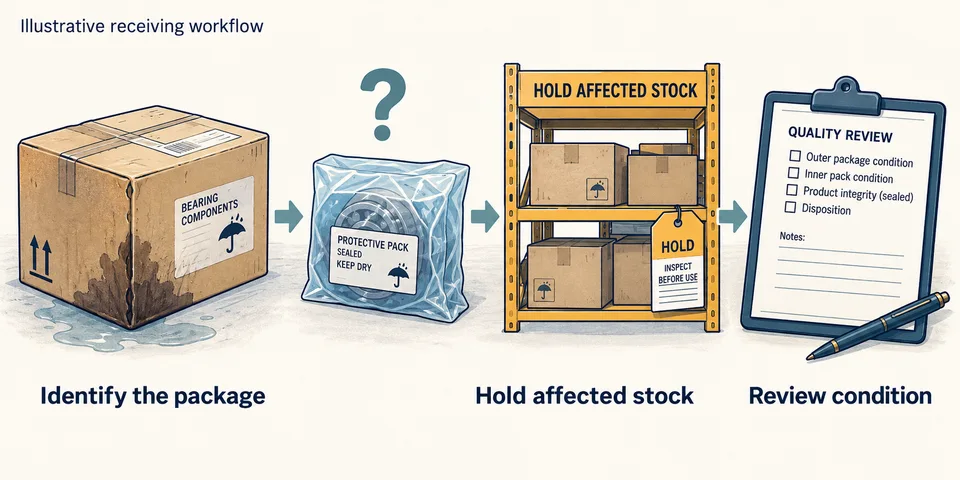
Separate package condition from product condition
Record the purchase order, supplier delivery reference, bearing designation, batch or serial identity where provided, package count and observed exposure. Photograph the packaging and labels without opening protective packs merely to complete the log.
SKF's bearing-contamination guidance explains that water can damage bearings and advises keeping new bearings packaged until mounting. Apply the relevant manufacturer's storage and inspection instructions for the specific item. Do not infer an acceptable moisture limit from a different bearing or packaging system.
| Question | Evidence to retain | Decision owner |
|---|---|---|
| Which items were exposed? | Package identity, item code, quantity and location | Stores |
| What is known? | Observed wetness, damage, exposure time if known and photographs | Receiving inspector |
| What remains unknown? | Inner-pack integrity, actual ingress or lost traceability | Quality |
| What evidence is needed? | Manufacturer or supplier instructions and authorised inspection plan | Technical and quality owners |
| What is the disposition? | Release, continued hold or return; exact quantity and authorisation | Authorised quality owner |
Reconcile the held and available quantities
Illustrative scenario: a receipt contains 60 individually identifiable bearing packs. Eight have visibly wet outer packaging. Stores identifies those eight, segregates them and checks whether evidence suggests a wider exposure affecting the other 52.
Until the review is complete, the eight remain unavailable for issue. The remaining 52 can follow normal receiving checks only if their identity and separation from the suspected exposure are reliable. A dry-looking carton is not enough to narrow the hold when the shipment's exposure boundary is unknown.
Suppose quality later authorises release of five affected packs based on the prescribed review and directs three to supplier return. The affected group reconciles as 5 released + 3 for return = 8. Keep each decision linked to its pack identity. If a pack contains several bearings, retain both pack count and piece count with their units.
Handle uncertain identity and urgent demand
If a label is unreadable, retain the original evidence and seek a traceable identification decision. Do not assign a nearby item's identity to the damaged pack. If the exposure boundary cannot be established, quality determines the wider hold scope and records the reason.
Do not dry, clean, relubricate or repackage a bearing as an improvised route to release. Obtain the applicable technical instructions first. Purchasing can coordinate the supplier response while planning reviews a different accepted stock source or a revised maintenance window.
An urgent breakdown does not change the receiving evidence. The requester should see the held quantity separately from usable stock, so a planner does not allocate an item that quality has not released.
Keep condition decisions attached to stock in Optiwise
Our inventory workflows support batch records and recorded stock actions. Materials requiring inspection can pass through our quality workflow before GRN closure. Configurable inspection forms and attachments let you record the condition evidence and authorised disposition with the receipt.
Set the pilot checks around traceability: every held pack has an identity and location, every released quantity has a decision reference, and each supplier return is reconciled to the affected group. Review any issue attempted before release and any hold awaiting an owner or supplier response.
Wet-package receiving questions
Should every wet carton be rejected immediately?
Record and hold the affected items while quality obtains the required condition evidence. The authorised disposition depends on the product, packaging and exposure.
Can we release stock because the bearing looks clean?
A visual appearance alone may not resolve moisture ingress or preservation concerns. Follow the item-specific inspection and release instructions.
Bring a redacted incoming inspection record to an Optiwise demo to map held stock, supplier follow-up and disposition.
Related Posts

Fabric Shade Groups: Allocate Rolls to a Cutting Lay
Allocate fabric rolls to cutting lays with shade-group approval, usable-length checks and remnant identity. Includes a two-group worked allocation example.
30 Sept 2026Read more →Powder Coating Reclaim: Keep Each Blend Traceable
Build a powder-coating reclaim record with parent lots, approved blend rules, mass reconciliation and job links. Includes a clearly illustrative balance example.
30 Sept 2026Read more →
Torque Tool Job Changes: Record the Approved Setting
Use a torque-tool job-change record to connect joint revision, units, tool identity, setup verification and the first affected assembly without inventing settings.
30 Sept 2026Read more →
Opened Adhesive Containers: Record Dates Before Reissue
Track partially used adhesive containers with opening dates, supplier limits, storage exceptions and an issue-return worksheet. Avoid invented expiry extensions.
30 Sept 2026Read more →