
Manufacturing AI or Hype? A Five-Question Evidence Test
Manufacturing AI or Hype? A Five-Question Evidence Test. Use a worked manufacturing test, explicit inputs and exception checks before rollout.
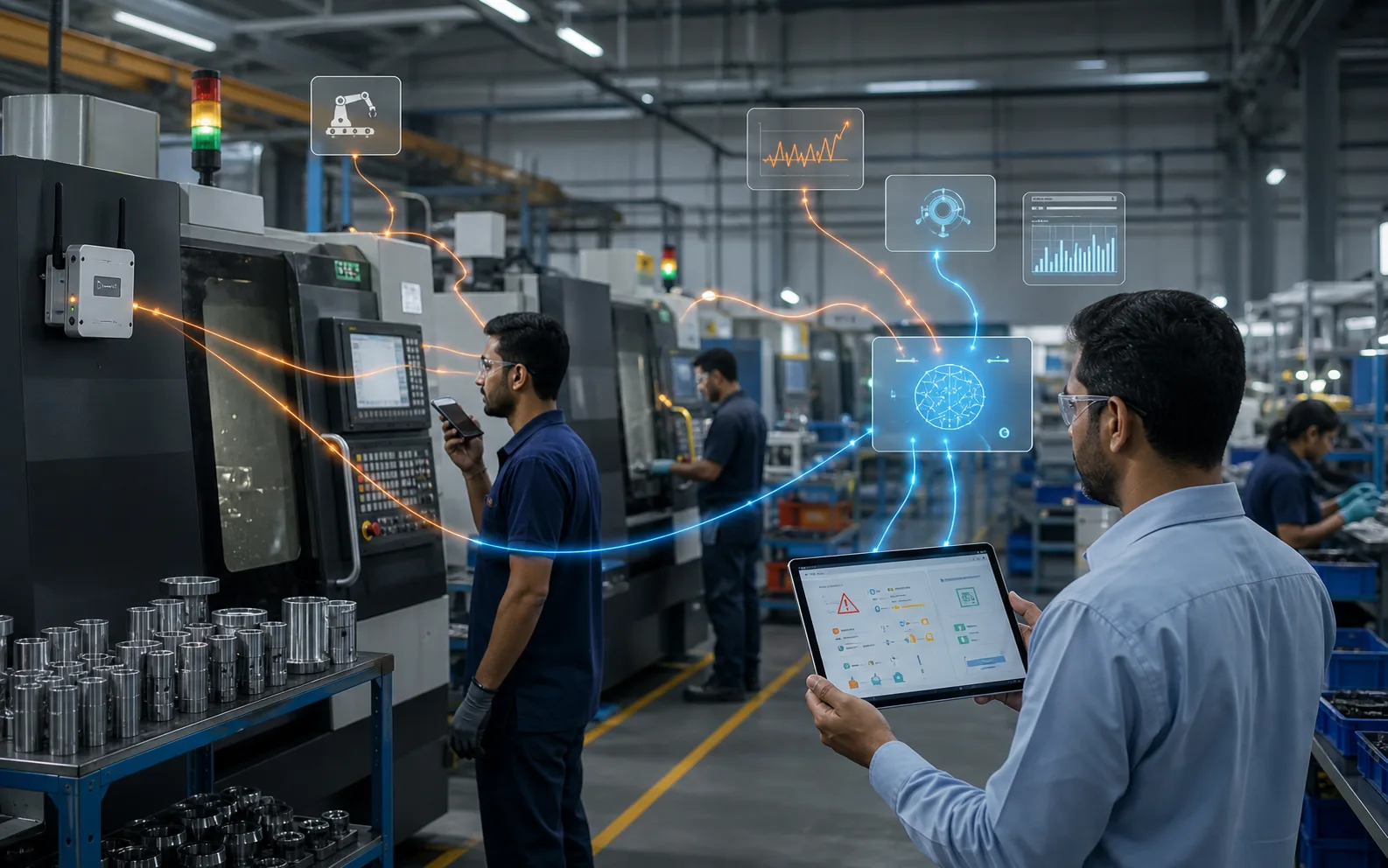
Manufacturing AI or Hype? A Five-Question Evidence Test helps you separate a useful factory AI workflow from a label. Test one real order and one exception before expanding scope.
A credible shortage assistant links the order, BOM demand, usable stock, open supply and approval limit. A chatbot that repeats “optimize inventory” without those records has not shown an operational use case.
Start with the decision the system must support
Ask what decision changes, which records support it, who may act and how a wrong answer is contained.
Our AI agents work on connected sales, production, purchasing, inventory and task records, and role permissions limit the records and actions available to each user.
Use NIST AI Risk Management Framework as an external reference for the relevant process or control model. It does not prove an Optiwise feature or business result; our product statements come from the current feature record.
| # | Input to prepare | Evidence to retain |
|---|---|---|
| 1 | Named factory decision | Owner and last update |
| 2 | Source records and timestamps | Definition and source |
| 3 | Role and approval boundary | Acceptance rule |
| 4 | Fallback when evidence is missing | Exception owner |
Run one controlled workflow
- 1. Named factory decision. Name the owner and authoritative record.
- 2. Source records and timestamps. Use the current value from the test order.
- 3. Role and approval boundary. Write the pass condition before the demo.
- 4. Fallback when evidence is missing. Assign the person who resolves a mismatch.
Keep the first test small enough to reconcile by hand. When the result differs from the source documents, identify whether the problem is master data, timing, transaction ownership or configuration.
Test exceptions with the normal flow
- Record is stale or incomplete
- Recommendation exceeds authority
- User cannot trace the answer
For every exception, record the expected status, permitted action, approver and audit trail. The workflow should expose a problem without allowing an unapproved shortcut to rewrite history.
Verify the connected Optiwise workflow
Review workflow details, product capability, supporting guide, implementation context, connected process, book a demo. In the demo, ask us to run the scenario with your roles and sample records. Confirm the source transaction, resulting status, action, correction method and report.
Questions to ask before rollout
What should we test first?
Choose one current order with a known complication. Prepare the four inputs above, run the sequence and reconcile the result with the source documents.
What result should we accept?
Accept the workflow only when the normal path and named exceptions leave a complete, role-appropriate record. Keep feature validation separate from a promised outcome.
Manufacturing AI is real, but there is also plenty of hype.
Some companies are using AI practically for downtime analysis, predictive maintenance, quality alerts, production scheduling, inventory optimization, procurement support, and reporting. Others use AI as a marketing label without changing much inside operations.
The difference is whether AI improves real decisions.
Where AI Is Real in Manufacturing
Practical AI use cases include predictive maintenance, machine health monitoring, defect pattern detection, production scheduling support, stockout alerts, supplier risk detection, and management summaries.
These use cases solve real operating problems.
Where Hype Appears
Hype appears when vendors make broad claims without showing workflow impact.
If AI cannot explain what data it uses, what decision it supports, or what result it improves, the claim should be questioned.
Manufacturers Are Starting at Different Levels
Some factories have IoT sensors and advanced analytics. Others are just beginning with digital production and inventory data.
Both can use AI, but the starting point differs.
AICAN Optiwise is built for manufacturers that need connected operations across production, inventory, purchase, sales, finance, reports, IoT readiness, and AI workflows.
How to Tell Real AI From Hype
Ask:
- What problem does it solve?
- What data does it use?
- What recommendation does it make?
- Can users explain the output?
- How is improvement measured?
- What happens when users disagree?
Real AI can answer these questions.
How Optiwise Supports the Workflow
AICAN Optiwise focuses on practical AI for manufacturing operations. The value is in connecting data and helping teams act, not in using AI as a buzzword.
Learn more at About AICAN.
Founder’s Note
AI becomes real when it helps someone make a better decision on a difficult day.
Manufacturers should demand practical proof, not futuristic language.
FAQ
Is AI actually used in factories?
Yes, especially for maintenance, scheduling, quality, inventory, procurement, and reporting.
How can I identify AI hype?
Look for vague claims without data, workflow, or measurable impact.
Do small factories use AI?
Yes, often starting with visibility, alerts, and reporting before advanced automation.
Does AI require robots?
No. Many AI use cases are software-led, not robotic.
Final Thought
Manufacturing AI is real when it improves visibility, timing, and decisions.
Ignore hype and focus on use cases that solve operating pain. That is the practical direction AICAN is building with Optiwise.

Related Posts
Is AI Worth the Investment for My Factory?
Learn how to decide if AI is worth the investment for your factory by evaluating use cases, data readiness, costs, risks, ROI, and operational impact.
13 Jun 2026Read more →Manufacturing AI Mistakes to Avoid Before You Start
List manufacturing AI mistakes and controls for unclear use case, messy data, unsafe automation, no owner, weak security and unreviewed recommendations.
13 Jun 2026Read more →What's the Difference Between AI and Regular Automation?
Understand the difference between AI and regular automation in manufacturing, with practical examples for workflows, decisions, alerts, and predictive operations.
13 Jun 2026Read more →What Are the Risks of Using AI in Manufacturing?
Understand the risks of AI in manufacturing, including bad data, wrong recommendations, safety issues, security, job fear, over-automation, and implementation failure.
13 Jun 2026Read more →