
External Test Samples: Reconcile Return, Retention and Use
Track samples removed from a manufacturing lot through laboratory receipt, destructive use, retention and physical return with a quantity worksheet.

When samples leave a manufacturing lot for external testing, record their identities and quantities separately from usable stock. Reconcile each sample as returned, consumed, retained or otherwise authorised for disposal; receiving the test report does not establish physical return or release.
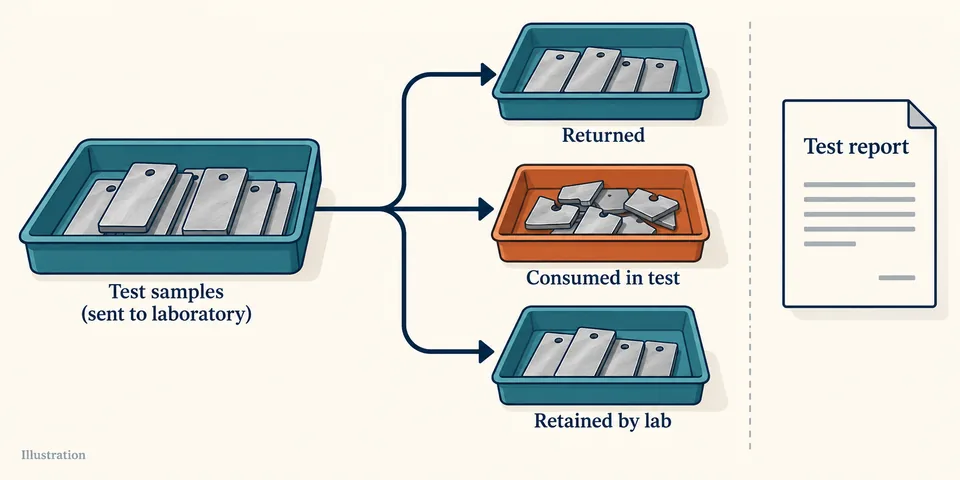
The quality coordinator receives a passing report and closes the test request. Stores still shows the samples as available even though some were destroyed and others remain at the laboratory. A sample custody register keeps the test result and the physical quantity decision separate.
Agree disposition when requesting the test
Before dispatch, record the parent lot, sample identifiers, quantity and unit, requested test, laboratory, packaging or handling instructions, and expected report date. Agree whether the test is destructive, whether remnants can be returned and whether any retention period applies. Obtain the relevant laboratory instructions rather than guessing what will happen to the samples.
The NPL and NGI characterisation request form explicitly asks about sample storage, return or disposal. That is a service-specific example of agreeing disposition in advance, not a universal rule for all laboratories. Use the instructions and contract for your actual test.
Remove samples from the available quantity
Stores records the movement out of usable stock into the appropriate sample custody state. Quality identifies what the sample represents and the decision the result will support. Keep the sampling plan separate from the custody calculation: a perfectly balanced quantity register does not prove that the sample was statistically representative.
| Disposition | Quantity | Evidence |
|---|---|---|
| Samples sent | 12 coupons | Dispatch list and laboratory receipt |
| Consumed by destructive testing | 5 coupons | Lab confirmation and test references |
| Retained by laboratory | 3 coupons | Retention reason and review/return date |
| Physically returned | 4 coupons | Receipt count and condition check |
| Unexplained difference | 12 − 5 − 3 − 4 = 0 | All samples accounted for |
The example assumes each coupon remains the accounting unit even if testing leaves fragments. Do not count three fragments as three returned coupons. If the laboratory changes the sample identity or splits it, retain the parent-child relationship and the agreed quantity basis.
Review the returned condition before restoring stock
A returned sample may have been marked, sectioned, stressed or otherwise altered. Stores confirms identity and quantity; quality decides whether it can return to usable stock, must remain retained or requires another disposition. A passing report about the parent lot does not automatically release the returned samples for production.
If four samples return but only three are suitable for the original use, record four physically returned and one held after receipt. Do not show only three returns and leave the fourth apparently at the laboratory. Location, custody and availability are separate dimensions of the record.
Follow retained and missing samples to a decision
For retained samples, name the custodian, reason, agreed date and owner of the next review. When the date arrives, record return, continued authorised retention or disposal evidence. A sample should not disappear from the open list because the commercial invoice was paid.
If the count does not reconcile, contact the laboratory through the responsible coordinator and preserve the discrepancy. Compare the dispatch acknowledgement, test-use record and return package. Close the discrepancy only with a documented explanation and authorised stock treatment. The count must never be corrected by changing the original quantity sent without evidence.
Connect sample custody and quality in Optiwise
Our sampling-based quality workflow supports sample quantities and configurable inspection parameters. Our inventory ledger records movements. Configure an attachment-supported form for laboratory custody, disposition and review dates, linking the sample record to its parent lot. The form documents decisions; it does not infer them from a report upload.
Accept a pilot when every dispatched sample has a current custodian or final disposition, the total reconciles, returned material has a separate availability decision, and retained samples have a future owner and date.
Sample-custody questions
Can the test report close the sample movement?
Only if the physical dispositions are also reconciled. A report communicates test results; it is not a receipt for returned material.
Should destructive-test material stay in available inventory?
No. Record the approved test consumption or other disposition using the correct unit and evidence. Retain its trace to the parent lot and test.
Map an external sample request and its return record in a demo.
Related Posts

Fabric Shade Groups: Allocate Rolls to a Cutting Lay
Allocate fabric rolls to cutting lays with shade-group approval, usable-length checks and remnant identity. Includes a two-group worked allocation example.
30 Sept 2026Read more →
Powder Coating Reclaim: Keep Each Blend Traceable
Build a powder-coating reclaim record with parent lots, approved blend rules, mass reconciliation and job links. Includes a clearly illustrative balance example.
30 Sept 2026Read more →
Torque Tool Job Changes: Record the Approved Setting
Use a torque-tool job-change record to connect joint revision, units, tool identity, setup verification and the first affected assembly without inventing settings.
30 Sept 2026Read more →
Opened Adhesive Containers: Record Dates Before Reissue
Track partially used adhesive containers with opening dates, supplier limits, storage exceptions and an issue-return worksheet. Avoid invented expiry extensions.
30 Sept 2026Read more →