
AI for Production Delays: Build an Explainable Exception Queue
AI for Production Delays: Build an Explainable Exception Queue. Use a worked factory test, explicit inputs and exception checks before rollout.

AI for Production Delays: Build an Explainable Exception Queue helps you use AI to prioritize delay risks without hiding the source records. Use one real order, one normal path and one exception in the evaluation.
An order is due in four days. The assistant identifies a late component, a loaded machine and an alternate in-house route, then asks the planner to approve the revised action.
Make the operational decision explicit
Show the affected order, shortage or capacity signal, recommendation, confidence boundary and approval owner.
Our AI agents work on connected sales, production, purchasing, inventory and task records, with permissions controlling the records and actions available to each user.
NIST AI Risk Management Framework is the external process or control reference for this guide: https://www.nist.gov/itl/ai-risk-management-framework. It does not prove an Optiwise feature or outcome; our product statements come from the current product record.
| # | Input | Evidence |
|---|---|---|
| 1 | Order and due date | Owner and definition |
| 2 | Material and capacity records | Authoritative source |
| 3 | Recommendation and reason | Acceptance rule |
| 4 | Approval and fallback | Exception owner |
Run the workflow with accountable roles
- 1. Order and due date. Name the person who owns the record and decision.
- 2. Material and capacity records. Use a current value from the representative order.
- 3. Recommendation and reason. Write the pass condition before the demo or rollout.
- 4. Approval and fallback. Assign correction and escalation responsibility.
Reconcile the test by hand. When the system result differs from the source record, classify the gap as master data, timing, transaction ownership, permissions or configuration before changing the workflow.
Test exceptions before rollout
- Source record is stale
- Two orders compete
- User lacks authority
For each exception, record the expected status, permitted action, approver, correction path and audit evidence. A fast normal path does not compensate for an uncontrolled exception.
Connect the page to the next buyer task
review the product workflow, check the supporting module, prepare implementation inputs, read the related guide, open the detailed workflow guide, book a connected demo. Ask us to run the scenario with your roles and representative records, including the exception and correction path.
Questions to settle in the demo
What should we prepare?
Prepare one representative order, the four inputs above and a complication your team encounters today. Remove confidential values if needed while keeping the record relationships intact.
What is a passing result?
Accept the workflow when the normal path and exceptions leave a complete, role-appropriate record that another person can reconcile. Keep capability validation separate from any promised business result.
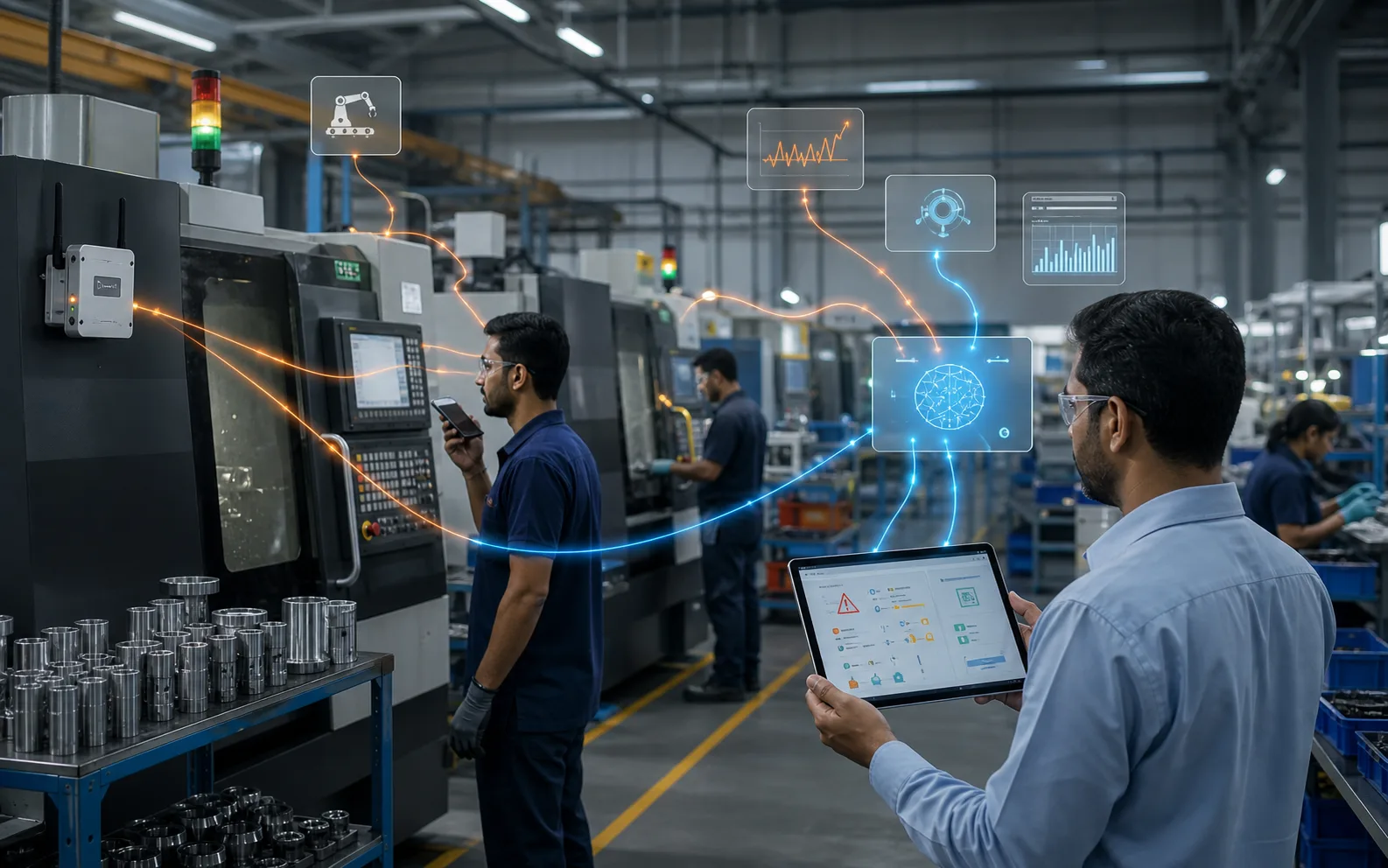
AI can reduce production delays by helping factories identify risks earlier. Most delays do not appear suddenly. They build through weak signals: material not arriving, machine downtime increasing, quality checks pending, purchase approvals stuck, or production running slower than planned.
AI helps by connecting these signals and alerting teams before the delay becomes unavoidable.
The value of AI is not magic. It is earlier visibility.
Material Shortage Alerts
Material shortage is a common cause of production delay. AI can compare production plans, inventory levels, purchase orders, vendor lead times, and consumption trends.
If a material may run short, the system can alert purchase and production teams early.
Machine Risk Detection
AI can study downtime history, maintenance records, spare usage, and machine behavior. It can flag machines that show rising risk or repeated stoppage patterns.
Maintenance teams can inspect before breakdown affects production.
Planning Variance Detection
AI can compare planned output with actual output and highlight jobs falling behind schedule.
It can also help identify likely causes such as material, machine, manpower, quality, or approval delays.
Quality Hold Visibility
Production may be complete but blocked due to quality hold. AI-assisted summaries can show pending inspections, repeated defects, and approval delays.
This improves coordination between production and quality.
Dispatch Risk Prediction
AI can connect production progress with customer delivery dates and dispatch readiness. This helps teams prioritize urgent orders.
How Optiwise Supports the Workflow
AICAN Optiwise connects production, inventory, purchase, sales, finance, and reporting so AI can work with real operational data.
AICAN helps manufacturers reduce delays through better visibility and AI-ready workflows. Learn more at About AICAN.
Founder’s Note
Delays become expensive when they are discovered late. AI should help teams see risk while there is still time to act.
That is the practical promise: not perfect prediction, but earlier action.
FAQ
Can AI eliminate production delays?
No. But it can reduce avoidable delays by identifying risks earlier.
What data does AI need?
Production plans, inventory, purchase orders, downtime, quality records, and dispatch commitments are useful.
Does AI replace planners?
No. It supports planners with alerts and summaries.
Where should factories start?
Start with material shortage alerts, production delay summaries, or downtime risk detection.
Final Thought
AI reduces production delays when it gives teams earlier warning and better context. The sooner a risk is visible, the more options the factory has.

Related Posts
Is AI Worth the Investment for My Factory?
Learn how to decide if AI is worth the investment for your factory by evaluating use cases, data readiness, costs, risks, ROI, and operational impact.
13 Jun 2026Read more →Manufacturing AI Mistakes to Avoid Before You Start
List manufacturing AI mistakes and controls for unclear use case, messy data, unsafe automation, no owner, weak security and unreviewed recommendations.
13 Jun 2026Read more →What's the Difference Between AI and Regular Automation?
Understand the difference between AI and regular automation in manufacturing, with practical examples for workflows, decisions, alerts, and predictive operations.
13 Jun 2026Read more →What Are the Risks of Using AI in Manufacturing?
Understand the risks of AI in manufacturing, including bad data, wrong recommendations, safety issues, security, job fear, over-automation, and implementation failure.
13 Jun 2026Read more →