
Replacement Motor Checklist: Compare the Nameplate and Specification
Compare a replacement motor with the approved specification. Record nameplate mismatches, receiving holds and engineering release evidence.

Accept a replacement motor against the approved equipment requirement, not power rating alone. Record the delivered identity, nameplate ratings, mounting information and supporting documents, then resolve mismatches before releasing it for installation.
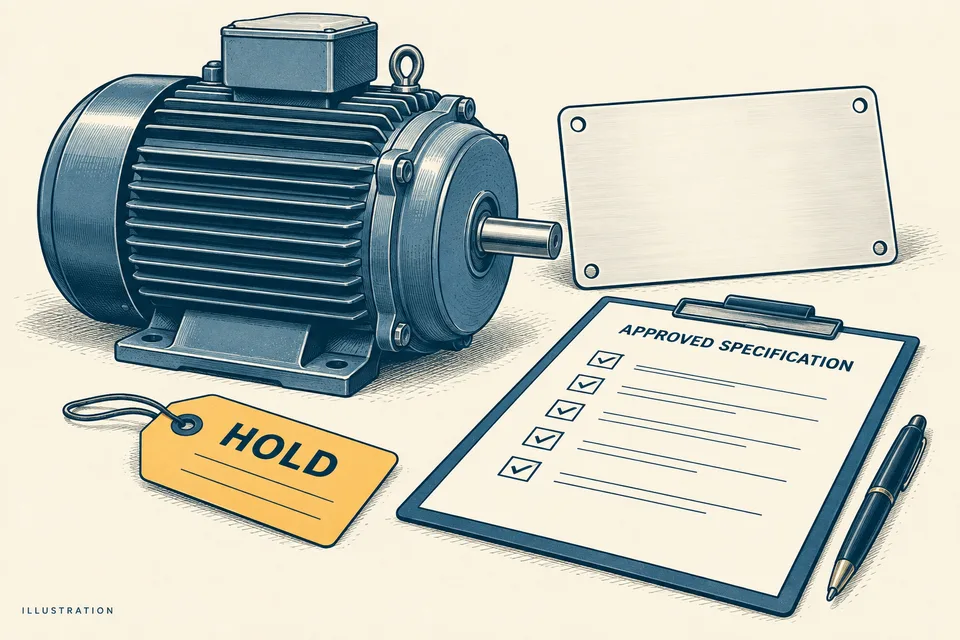
A replacement motor arrives with the requested power rating. Receiving can count the package and identify the item, but the maintenance engineer must still establish that the delivered configuration meets the approved requirement.
Collect the requirement and the delivered identity
Start the review at purchase receipt, before the motor is allocated to an installation job. The buyer supplies the approved specification and purchase order. Stores captures manufacturer, model, serial number, package condition and readable nameplate photographs. The maintenance or electrical engineering owner compares the technical details.
ABB’s explanation of NEMA motor nameplates identifies fields including voltage, frequency, full-load speed and frame. It is a reference for interpreting those fields, not an approval for a specific replacement. Use the documentation for the delivered motor’s standard and configuration; do not translate a NEMA frame designation into an IEC mounting assumption.
Complete a field-by-field comparison
| Field group | Evidence to compare | Record the outcome |
|---|---|---|
| Identity | Manufacturer, model and serial against PO and delivery documents | Exact identity or discrepancy |
| Electrical ratings | Power, voltage, frequency, phase and rated current | Values with units and document source |
| Speed and duty | Rated speed and required operating duty | Match or engineering review |
| Mechanical interface | Frame, mounting, shaft and relevant drawing | Approved drawing reference |
| Environment and protection | Required enclosure and application-specific certification | Evidence received or missing |
| Associated requirements | Specified accessories, sensors and drive-related requirements | Verified against approved specification |
| Release | Technical reviewer, decision, conditions and date | Accept, hold or reject with reason |
A nameplate may not contain every required detail. Link the manufacturer’s data sheet or certified document for the remaining fields. Leave missing evidence explicit. A supplier’s broad statement that a motor is “equivalent” does not fill the individual comparison lines.
Keep a frequency mismatch visible
Illustrative scenario: the approved purchase requirement specifies 50 Hz. The delivered motor’s visible nameplate lists only 60 Hz. Its power rating matches the purchase order, but receiving cannot infer a 50 Hz rating from that match.
Stores records the motor as held and retains the plate photograph. Purchasing asks for the model-specific documentation. The responsible engineer decides whether the delivered unit meets the actual requirement or requires return. Any approval must identify the exact motor and its conditions. The worksheet offers no connection change or operating adjustment.
If the plate has several voltage or frequency combinations, preserve each combination as shown. Do not combine one row’s current with another row’s voltage to construct a rating the manufacturer did not state.
Resolve documents and physical condition separately
A correct specification does not settle visible shipping damage. Record condition and technical match as separate review branches, with an owner for each. Likewise, intact packaging does not settle a missing certificate or unreadable serial number.
An urgent breakdown changes the priority of the review, not its evidence requirement. If a substitute is proposed, retain the bounded substitution approval. If a motor is taken from another machine, also retain the donor-machine restoration record.
Release the item with a complete receiving trail
Close receiving acceptance when the delivered identity is traceable, every required comparison is resolved, supporting documents are attached and the named technical authority has signed the decision. Any continuing installation conditions travel with the item. Receiving acceptance and permission to energise the machine are separate decisions.
Review the number of unresolved motor receipts, their age and the document causing delay. That can improve the next purchase specification without pretending that a fast receipt proves correct installation.
Link the receiving gate in Optiwise
Our purchase-receipt quality workflow moves materials requiring QC through inspection before GRN closure. Configurable QC forms and attachments can hold the comparison, nameplate photographs and decision evidence. Connect the accepted item to its movement history in Optiwise inventory.
Motor-acceptance questions
Is matching kilowatts enough to accept a replacement motor?
No. Compare the complete approved requirement, including ratings, mechanical interface and application-specific conditions. A qualified reviewer resolves any difference.
Does a passed receiving checklist authorise energisation?
No. Installation, testing and return to service follow the equipment’s authorised procedures and responsible technical personnel.
Bring a motor PO and its receiving checklist to an Optiwise demo to map the document and quality gates.
Related Posts

Fabric Shade Groups: Allocate Rolls to a Cutting Lay
Allocate fabric rolls to cutting lays with shade-group approval, usable-length checks and remnant identity. Includes a two-group worked allocation example.
30 Sept 2026Read more →
Powder Coating Reclaim: Keep Each Blend Traceable
Build a powder-coating reclaim record with parent lots, approved blend rules, mass reconciliation and job links. Includes a clearly illustrative balance example.
30 Sept 2026Read more →
Torque Tool Job Changes: Record the Approved Setting
Use a torque-tool job-change record to connect joint revision, units, tool identity, setup verification and the first affected assembly without inventing settings.
30 Sept 2026Read more →Opened Adhesive Containers: Record Dates Before Reissue
Track partially used adhesive containers with opening dates, supplier limits, storage exceptions and an issue-return worksheet. Avoid invented expiry extensions.
30 Sept 2026Read more →