
Restart Dormant WIP: A Work-Order Release Checklist
Recheck held work before restarting: customer demand, quantity, identity, condition, revision and resources, with a worked WIP release example.

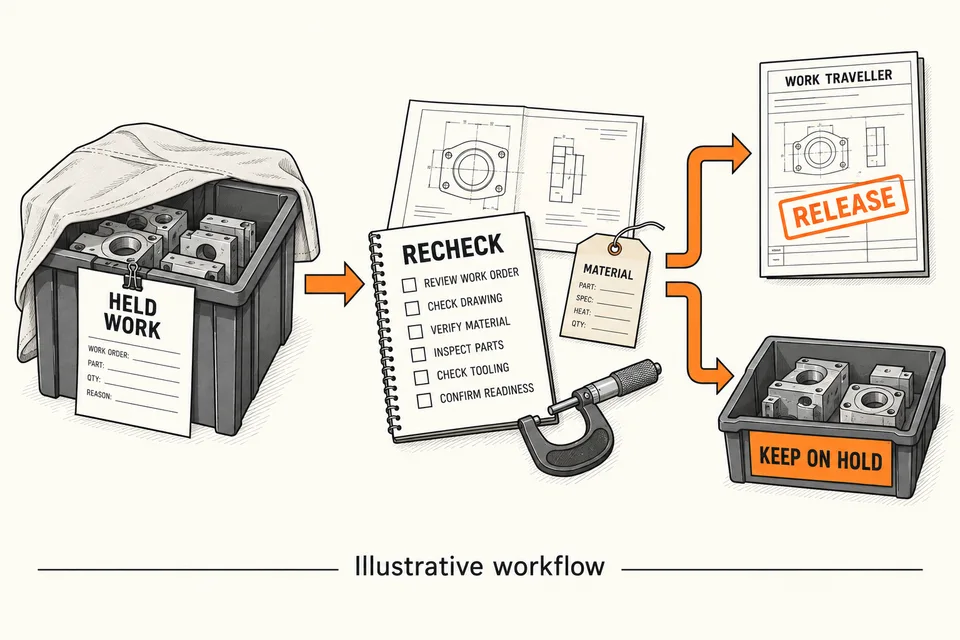
Restart a dormant work order only after confirming the current customer requirement, the identity and condition of unfinished goods, the applicable drawing and route, and the resources needed for the next operation. Record an explicit release decision for the quantity allowed to resume.
This workflow is for a planner asked to restart a job that has sat on hold while material, approval or demand was unresolved. It addresses release readiness for existing WIP. It does not change the original production history or prescribe an accounting valuation.
Keep the old job history intact
Retrieve the work order, last completed operation, issued materials, output and rejection records, hold reason and last known location. Find the customer requirement that now makes restarting necessary. A request to “finish the old batch” needs a named order and quantity.
Our WIP guide explains unfinished production. This restart record adds a decision point for material that has been inactive long enough for its assumptions to need review.
NASA's configuration-management guidance emphasizes consistency between product and approved configuration information. Apply that principle by checking the instruction applicable to the old WIP, rather than assuming the latest drawing automatically applies to it.
Count and classify before scheduling
| Physical group | Quantity | Restart decision needed |
|---|---|---|
| Identified machined parts, condition accepted | 72 | Engineering confirms the applicable revision and next operation |
| Identified parts with a condition concern | 12 | Quality reviews before further processing |
| Parts with incomplete identity | 6 | Hold while traceability is investigated |
| Known rejected parts | 10 | Retain rejection status and approved disposition |
The four groups reconcile to 100 pieces. If the current customer requirement is 80, the immediately eligible group of 72 leaves a gap of eight, subject to the remaining release checks. Do not count the 12 condition-held or six unidentified pieces as usable supply simply because they exist physically.
These numbers are illustrative. The quality owner supplies the actual condition criteria and inspection scope for the material, process and storage history. A visual check alone may not establish suitability.
Review what changed while the job waited
Engineering checks drawing and process changes, including whether the old WIP can continue under its original instruction or needs an approved conversion. Quality checks open nonconformances and any inspection, preservation or time-sensitive requirements. Stores checks identity, location and the remaining material needed.
The planner checks the next machine, fixture, skill, shift and outside-process availability. The sales owner confirms that the customer still needs the quantity and agrees the delivery commitment. Record each decision beside its evidence and name the person who can resolve an exception.
A part that sat untouched may still face a changed requirement. Conversely, a newer drawing may apply only to future orders. Preserve the effective scope instead of relabelling all old work with the latest revision.
Release a bounded restart quantity
For the example, the release could authorize the 72 accepted, identified pieces after all other checks pass. Keep the remaining 28 in their separate statuses. If quality later releases eight more pieces, add that decision with its timestamp and evidence; do not rewrite the first release as if 80 were approved from the beginning.
Issue the next operation's instruction with the job identity, released quantity, applicable revision, required inspection and responsible supervisor. Record the first resumed production entry against the existing work history. If the business uses a new linked job for the remaining operations, retain the parent relationship so prior issues and outputs are not duplicated.
When evidence is missing, record what cannot be established. Creating a new work order number does not repair lost identity. When the customer cancels the requirement, route the WIP for a disposition decision instead of restarting it to make the production board look complete.
Verify the first resumed operation
The supervisor confirms that the operator has the released instruction and the correct physical group. Quality applies the approved first-operation or first-piece check where required. Record the accepted output, any new hold and the remaining quantity.
For a pilot, review three dormant jobs. Acceptance means physical quantities reconcile, every released group has identity and condition evidence, the original hold has been resolved or explicitly superseded, and the next operation has a named owner. Track jobs that return to hold after restart and investigate the missing check.
Reconnect the job in Optiwise
We connect work orders, material issues, process entries, rework and quality activities in Optiwise production. Configurable forms can capture the restart review, while related records preserve the connection between the old job, held groups and new decisions. Machine calendars and worker availability support the revised schedule.
Use the quality queue for pending inspections and keep unresolved groups visible to planning. A new promised date should follow the approved quantity and resource decisions.
Questions about restarting WIP
How many idle days make a job dormant?
Set a review trigger for your product and process. Time-sensitive materials, changed requirements or poor storage evidence may require review sooner than a stable identified component.
Should we create a new work order?
Use the approach that preserves your traceability and transaction controls. If a new job is needed, link it to the original and prevent duplicate material consumption or completed quantities.
Bring one held job and its physical quantity breakdown to an Optiwise demo so we can map a controlled restart.
Related Posts

Fabric Shade Groups: Allocate Rolls to a Cutting Lay
Allocate fabric rolls to cutting lays with shade-group approval, usable-length checks and remnant identity. Includes a two-group worked allocation example.
30 Sept 2026Read more →
Powder Coating Reclaim: Keep Each Blend Traceable
Build a powder-coating reclaim record with parent lots, approved blend rules, mass reconciliation and job links. Includes a clearly illustrative balance example.
30 Sept 2026Read more →
Torque Tool Job Changes: Record the Approved Setting
Use a torque-tool job-change record to connect joint revision, units, tool identity, setup verification and the first affected assembly without inventing settings.
30 Sept 2026Read more →
Opened Adhesive Containers: Record Dates Before Reissue
Track partially used adhesive containers with opening dates, supplier limits, storage exceptions and an issue-return worksheet. Avoid invented expiry extensions.
30 Sept 2026Read more →