
How to Trace a Regrind Bag Before It Reaches the Hopper
Trace a recovered resin bag through weighing, job issue and actual hopper entry. Resolve a missing grade or source lot before approving reuse.


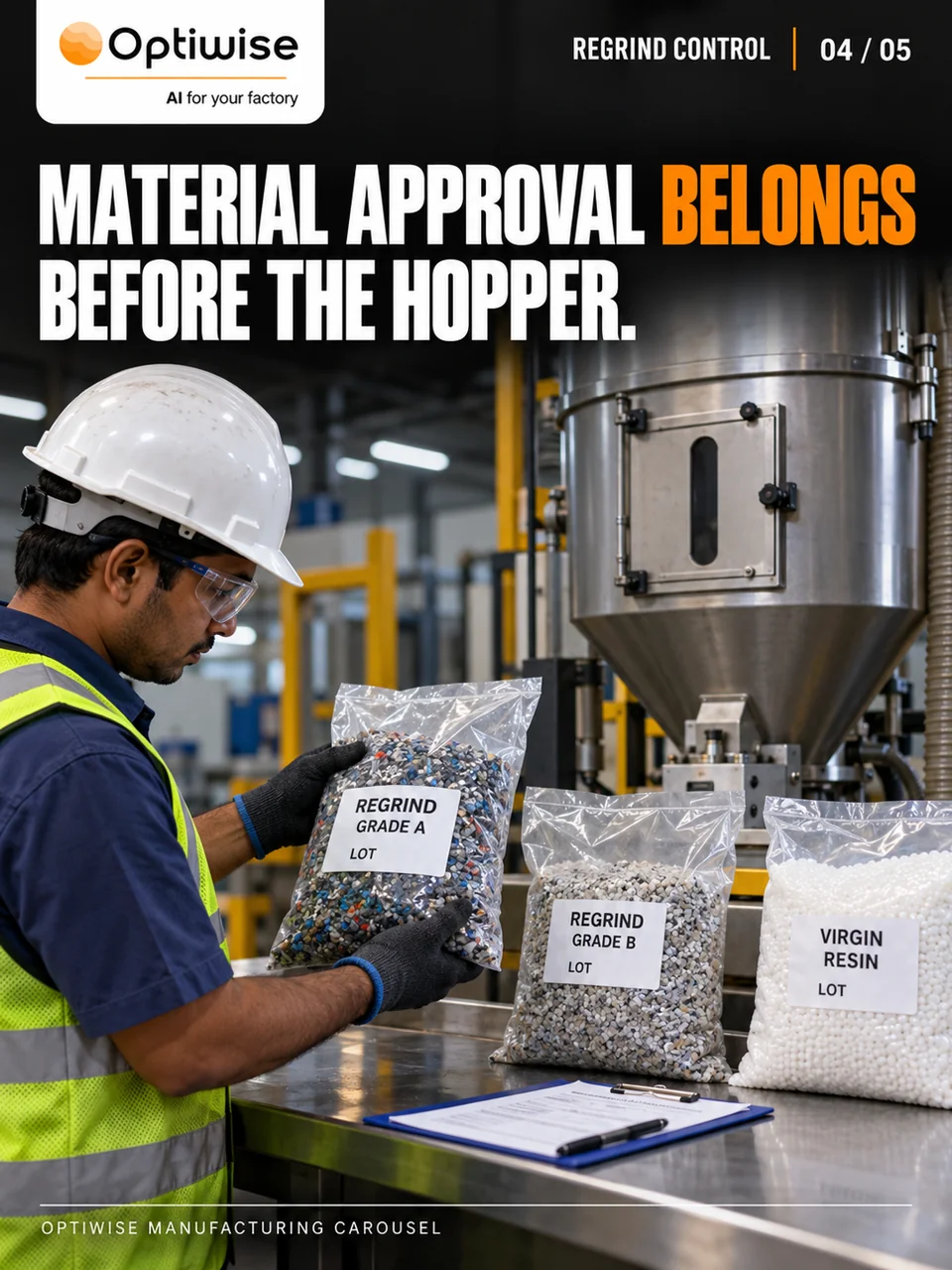
Keep the grade and source job with every bag of plastic regrind. If its identity becomes uncertain after a draw, hold the remainder and establish whether any material entered the receiving job.
Record the grade when the material is recovered
Collecting material from runners and rejected parts creates a new handling record. Give the recovery bag its own identifier. Link the resin grade, source lot and job, net recovered mass, time, location and quality status. If several sources were mixed, capture the known inputs and flag the missing ones. Colour and appearance alone cannot recover a missing material identity.
BASF’s Ultramid processing brochure discusses contamination, moisture and repeated processing in its section on regrind. Use the guidance for your exact material and the authorised rule for the receiving product. Record the approved use, any required drying evidence and the person who releases the bag.
Find out where the weighed material went
Consider a 5 kg recovery bag, R17. The operator weighs 2 kg for job M42 and leaves 3 kg in the bag. At handover, a second tag appears with a different grade. The immediate question is whether the 2 kg is still in its staging container or has already entered the hopper.
If the weighed quantity is still staged, the original 5 kg is physically accounted for as 2 kg staged and 3 kg remaining. Hold both identified portions for a decision. If the 2 kg has already entered M42, preserve that actual input, hold the remainder and refer the affected production to the authorised reviewer. Use the recorded job and entry time to identify the output that may have received it. Where the entry time is missing, retain the wider possible interval until the evidence supports a narrower one.
A stores issue tells you what was supplied to production. The operator’s process record tells you what entered the job. Compare both with the remaining bag weight and any separately staged quantity. Record any unexplained difference and give it an owner before the next use.
Keep the bag, issue and review linked in Optiwise
Our lot and barcode records identify the recovery bag, its location and movements. Use the actual material issue against the production job. We can configure fields for the recovery source, released use, actual weighed draw, hopper entry and exception evidence. The recorded approval and process entry give your next shift a basis for choosing another released bag or waiting for a decision.
For a job review, open the bag record and follow each recorded draw to its destination. Start from the affected production job when you need to check which recovered bag and virgin lot supplied it. Retain the original records when quality corrects a label or assigns a final disposition.
For the wider run history, our worked plastics batch record connects the material lots to the machine, mould and inspection.
Which blend percentage should we enter?
Enter the value approved for the actual material, product and customer requirements. Keep the approved instruction with the record and capture the amounts actually used in the run.
Bring one recovery bag and its job issue to an Optiwise walkthrough. We’ll map the record from recovery to the next authorised use. Implementation costs ₹0. Subscription, optional add-ons and IoT hardware are separate.
Related Posts
Food Rework Traceability From the Tub to the Receiving Batch
Trace an approved food rework tub into the receiving batch. Record what was issued, used, returned and held with a worked quantity example.
4 Nov 2026Read more →Splitting a Supplier Lot Across Containers Without Double Counting
Follow a supplier lot through two container splits. Reconcile actual stock, retire the emptied tote and keep held pieces visible in Optiwise.
4 Nov 2026Read more →Solder Paste Tracking: Keep Each Jar’s Storage and Opening History
Track solder-paste jars beyond the expiry date. Keep storage removal, opening, job issue and returned paste linked, with a worked timing example in Optiwise.
3 Nov 2026Read more →Chemical Batching: Verify the Ingredient Before Charging
A correct weight can hide the wrong ingredient. Follow approved material, actual lots, weighing evidence and exceptions in an Optiwise batch workflow.
3 Nov 2026Read more →