
Solder Paste Tracking: Keep Each Jar’s Storage and Opening History
Track solder-paste jars beyond the expiry date. Keep storage removal, opening, job issue and returned paste linked, with a worked timing example in Optiwise.


Give each solder-paste jar its own handling record before issue or return. In Optiwise, we link its material identity, movement, job and recorded checks so you can distinguish an in-date jar with known history from one that needs a quality decision.
Two jars share the same supplier lot and expiry date. One has a recorded storage-removal and opening history; the other is on the bench with no reliable removal time. Their printed dates match, but the evidence available for the next production decision differs.
Keep the product rule with the jar
Record the paste product, supplier lot, container identity, expiry, relevant supplier instruction and storage location. Your technical team defines the applicable storage, preparation, use and return rules for that exact product and container type. Record the events and conditions needed to apply those rules.
Nordson EFD’s PrintPlus printing guidelines distinguish refrigerated storage, preparation before use, ambient conditions and keeping containers closed. They also caution against mixing used paste into new paste. These are instructions for the named product family. Do not copy one temperature or duration into a universal rule for every solder paste.
Track overlapping times without adding them twice
Consider this illustrative chronology for jar J-01: removed from controlled storage at 08:10, opened at 10:05, then reviewed at 12:10. The elapsed period since removal is four hours. The elapsed period since opening is two hours and five minutes. The opening period sits inside the removal period; adding them would report a misleading six hours and five minutes.
| Jar | Recorded history | Next decision |
|---|---|---|
| J-01 | Removal 08:10; opening 10:05; job reference retained | Apply the exact product rule to the recorded conditions and times |
| J-02 | Removal time unknown; same supplier lot and expiry | Keep unresolved for the responsible quality review |
These times demonstrate record arithmetic, not a permitted warm-up or use limit. A timestamp alone does not prove the material reached the required condition. Returning a jar to storage also does not erase its earlier exposure or opening history. Record the return as another event and follow the applicable supplier and site procedure.
Separate unused material from paste collected after printing
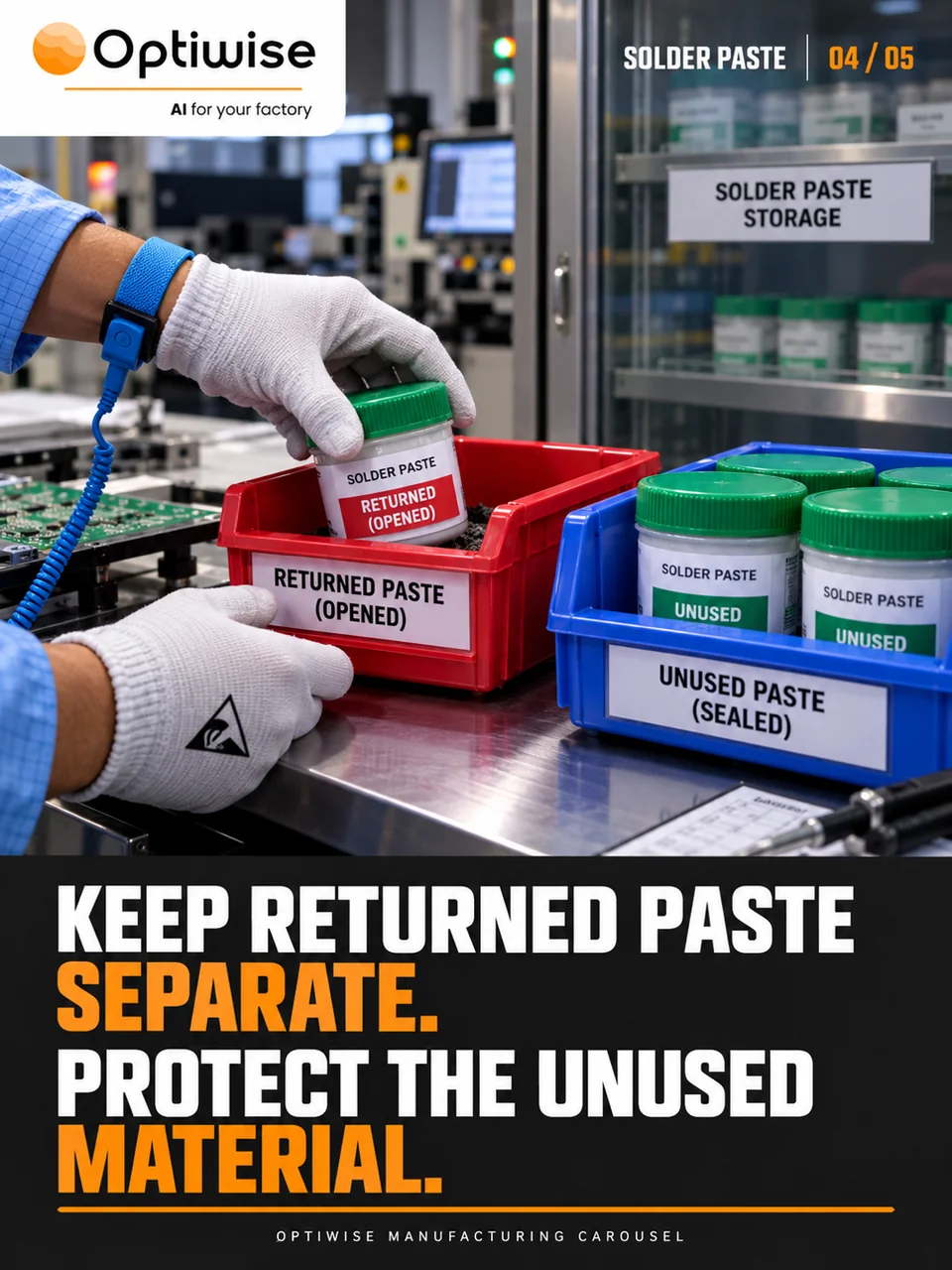
Identify paste collected from the stencil separately from material remaining in its original jar. Retain the source jar, job, collection time, quantity where measured, container and disposition. Do not pour used paste into unused stock or create a fresh identity that hides its history. Whether any collected paste may be reused is a product- and process-specific quality decision.
If the previous shift left an unlabelled container, keep the unknowns visible. Ask for the actual source and handling evidence; another jar’s log cannot supply the missing times. Where the procedure requires segregation pending a decision, the physical container and its stock/workflow status need to agree. A printed expiry date alone does not resolve that exception.
Follow the jar through Optiwise
Our inventory workflow supports item, batch/lot and individual barcode identities, stores and issue/return movements. Choose a jar-level identifier when several containers from the same supplier lot can have different histories. Connect the issue to the relevant production job so the supervisor can follow which material was supplied to the work.
We configure the jar history and process form with the product instruction, storage-removal time, opening event, job, operator, condition evidence and next responsible role. Our no-code tools provide required fields, attachments and related records; our quality forms and queue retain the relevant result and disposition. Your team records the physical events as they happen and applies the approved rule.
A barcode record does not automatically measure temperature, start a validated exposure timer or block a printer. If you need sensor capture, timed escalation or a machine interlock, define the equipment, signal, rule and acceptance check as a separate implementation scope. Keep a manual recorded observation distinct from a continuous temperature history.
Use the history when investigating a printing problem
Follow the jar and supplier lot into the affected job, process entries and inspection records. Keep handling evidence alongside the other possible causes: printer setup, stencil, board, environment and the inspection result. The timing record helps the technical team investigate; it does not establish that paste handling caused a particular solder defect.
Is one supplier lot number enough for several jars?
Keep the shared lot for supplier traceability and a separate container identity where the jars have different handling events. A common expiry date does not give them a common opening history.
Does putting a jar back in storage reset its history?
Retain the earlier events and add the return. Apply the exact product and site procedure to that history; a location change does not create a new unopened jar.
Bring two paste jars with different handling histories to a factory walkthrough. We will map the container identity, job issue, unresolved evidence and quality handoff in Optiwise. Implementation costs ₹0; subscription, optional add-ons and IoT hardware are separate.
Related Posts
Chemical Batching: Verify the Ingredient Before Charging
A correct weight can hide the wrong ingredient. Follow approved material, actual lots, weighing evidence and exceptions in an Optiwise batch workflow.
3 Nov 2026Read more →Fastener Returns: Check Grade, Coating and Lot Before Restocking
Handle mixed fastener returns without overstating usable stock. Follow the item, grade, coating, lot and quality decision through a worked Optiwise example.
3 Nov 2026Read more →
Optiwise Optimize Savings: What Shop-Floor Follow-Ups Are Worth
Test whether less shop-floor chasing can cover Optimize: a floor-only example, 13.3-minute break-even, job records, costs and editable calculator inputs.
2 Nov 2026Read more →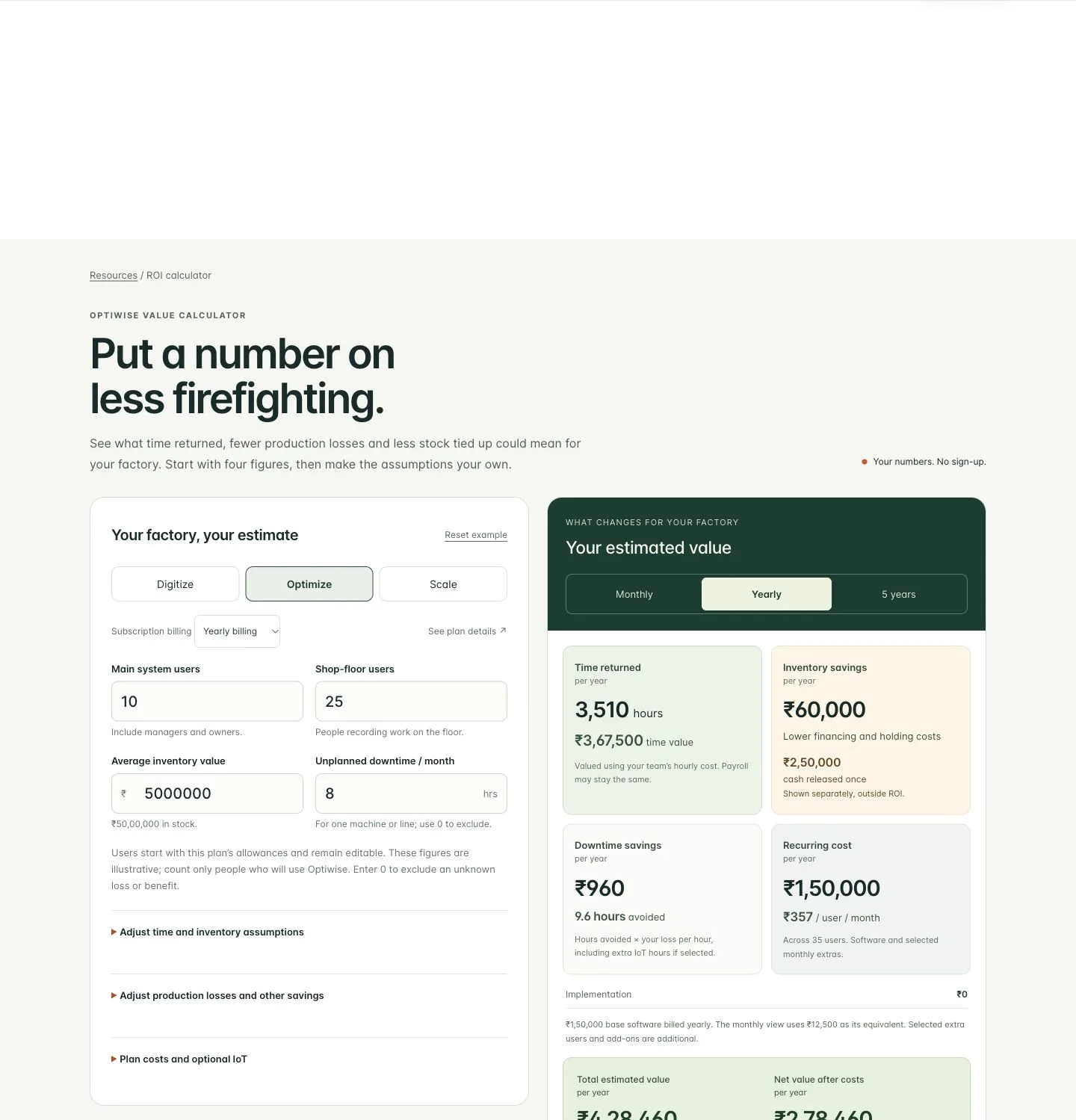
How Much Can Optiwise Save Your Factory?
See a worked Optiwise savings example with time returned, stock carrying costs, software and optional IoT. Use our free calculator for your own factory ROI.
2 Nov 2026Read more →