
Do You Need New Equipment to Use AI in a Factory?
Give factories a decision tree for ERP-only AI, manual entry, IoT edge devices, sensors and machine-controller options with OptiEdge boundaries.

Factories often assume AI requires new machines. Many useful AI workflows start with the records already created by sales, purchase, inventory, production and quality teams.
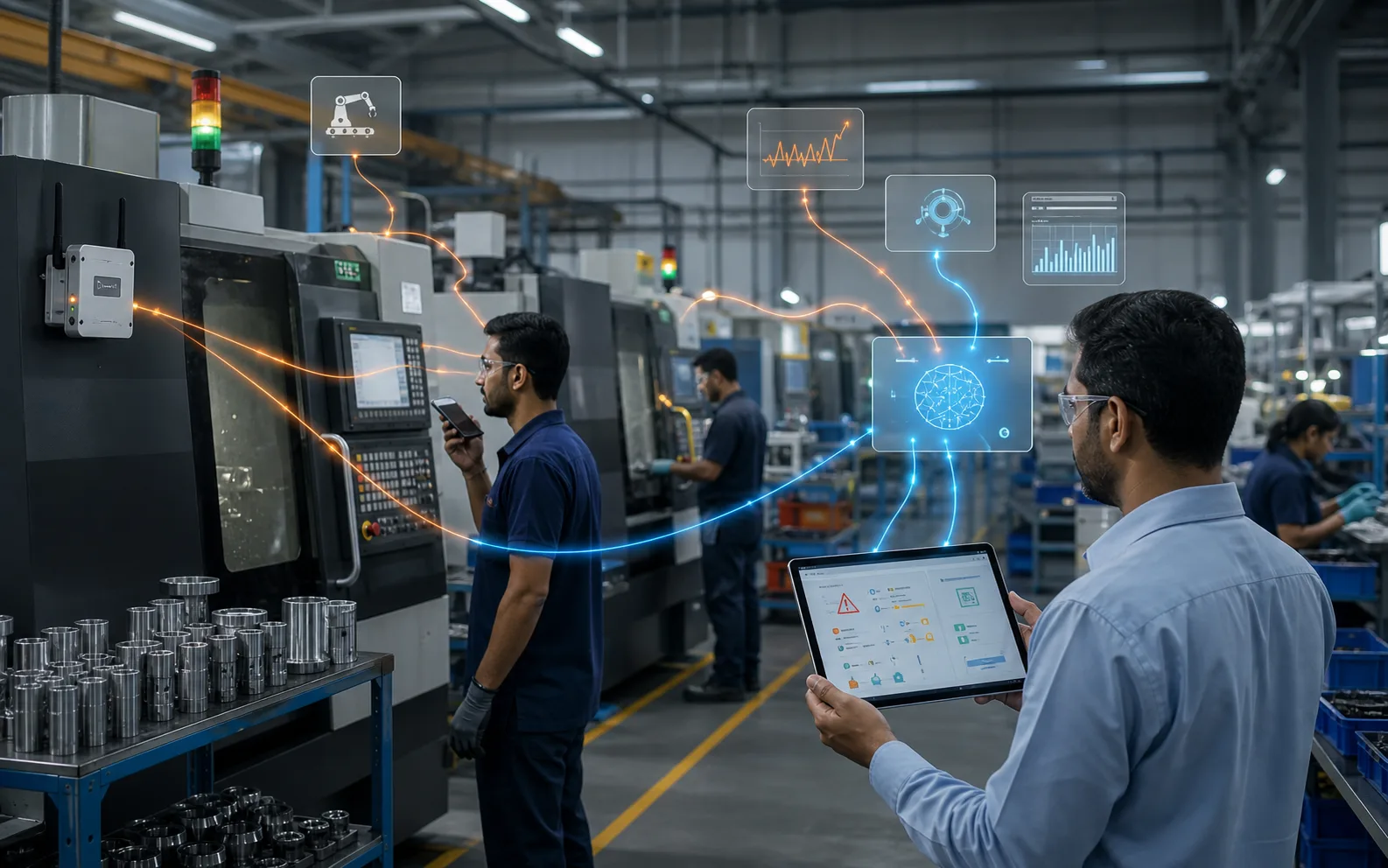
New equipment becomes relevant when the decision needs real machine signals such as runtime, downtime, load, power, cycle or vibration. Optiwise supports both business-record AI and IoT-backed machine intelligence.
Direct answer
You do not always need new equipment for AI. Start with ERP records, add manual capture where needed, and use IoT devices only when the decision needs machine signals.
Factory example
A factory wants to know why jobs are late. Sales orders, BOM, stock, open POs and work-order status may be enough for the first answer. If the real uncertainty is machine stop time, then OptiEdge or sensors may be needed.
Worksheet for the decision
| Area | What to check | Why it matters |
|---|---|---|
| Decision need | Starting point | When equipment is needed |
| Order risk | Sales, stock, purchase and production records | Usually no new machine device |
| Material shortage | BOM, stock, PO and production plan | No device needed |
| Operator process entry | Manual supervisor/operator records | Tablet or terminal may help |
| Runtime and downtime | Machine state signal | OptiEdge or controller/sensor access |
| Energy use | Power or meter signal | Meter or OptiSense path |
| Machine health | Vibration/load pattern | Sensor or controller signal |
How Optiwise supports this workflow
- Use ERP records first for orders, stock, purchase, quality and production.
- Use OptiEdge for machine data collection and edge processing where machine access exists.
- Support Modbus/OPC-UA and Wi-Fi/Ethernet paths where the site and machine allow them.
Use the related Optiwise workflows for AI agents, production, inventory, purchasing, quality and industrial IoT.
Implementation notes
Use new equipment only where it changes the decision. If planners need better shortage review, ERP records may be enough. If maintenance needs vibration or runtime patterns, sensors or controller access may be needed. If management needs energy per good unit, meter and production-output records must connect. The equipment decision follows the use case.
Source and control checks
For AI risk and governance language, compare your project controls with the NIST AI Risk Management Framework. For connected device access and security planning, also review CISA cybersecurity performance goals where applicable.
Before using the recommendation, confirm the record owner, source timestamp, approval rule and missing-data handling. Keep customer results, savings numbers, safety certification and regulatory claims out of the page unless there is separate evidence for that exact claim.
Buyer review before rollout
Before rollout, review one finished transaction from start to end. Check the source record, the recommended action, the approval step, the person who accepted or rejected it and the operational result. This review catches weak data, vague ownership and unsafe automation before the workflow reaches more users. Keep the pilot narrow until the team can explain the recommendation in plain factory language.
FAQs
Do we need to replace old machines for AI?
Not always. Some use cases need only controlled business records; others need sensors or edge devices.
When should we add IoT?
Add IoT when the decision depends on real machine state, energy, cycle, load or vibration data.

Related Posts
Is AI Worth the Investment for My Factory?
Learn how to decide if AI is worth the investment for your factory by evaluating use cases, data readiness, costs, risks, ROI, and operational impact.
13 Jun 2026Read more →Manufacturing AI Mistakes to Avoid Before You Start
List manufacturing AI mistakes and controls for unclear use case, messy data, unsafe automation, no owner, weak security and unreviewed recommendations.
13 Jun 2026Read more →What's the Difference Between AI and Regular Automation?
Understand the difference between AI and regular automation in manufacturing, with practical examples for workflows, decisions, alerts, and predictive operations.
13 Jun 2026Read more →What Are the Risks of Using AI in Manufacturing?
Understand the risks of AI in manufacturing, including bad data, wrong recommendations, safety issues, security, job fear, over-automation, and implementation failure.
13 Jun 2026Read more →